Back and lay betting cricket exchange is the single most powerful upgrade an Indian bettor can make to their betting approach — yet it remains one of the least understood concepts in the Indian cricket betting market. Most Indian bettors have heard the terms. Very few actually understand what back and lay betting on a cricket exchange means in practice, how liability works on lay bets, and why exchange odds consistently outperform sportsbook odds by 5–10% on the same market.
This guide covers back and lay betting on cricket exchanges from first principles. What backing means. What laying means. How liability is calculated on lay bets with three worked IPL rupee examples. Why the cricket exchange model produces better financial outcomes for regular bettors than the sportsbook model. And which Indian platforms offer the best back lay cricket exchange experience in 2026.
No assumed knowledge. Complete clarity on every concept.
Last updated: April 2026
What is a Cricket Exchange? — The Foundation
Before back and lay betting makes sense, the cricket exchange model needs to be clear.
A cricket exchange is a platform where bettors trade against each other — not against the platform. When you place a back bet on India to win, a lay bettor on the same exchange takes the opposite position. The platform matches you. It does not care who wins — it collects a small commission on winnings from both sides and has no financial stake in the outcome.
This is fundamentally different from a sportsbook, where the platform itself is your opponent. On a sportsbook, when you win, the platform loses. This conflict of interest is why sportsbook odds are deliberately set worse than true probability — the platform needs a built-in margin to profit regardless of outcomes.
On a cricket exchange: No conflict of interest. The platform profits from commission regardless of who wins. This allows exchange odds to sit much closer to true probability — which is why back lay betting on a cricket exchange consistently delivers better financial returns for regular bettors.
The most widely used cricket exchange platform available to Indian bettors in 2026 is TigerExch — the only true peer-to-peer cricket exchange in the verified Indian market with documented IPL liquidity.
Back Betting on a Cricket Exchange — Explained
Back betting on a cricket exchange means betting FOR a specific outcome to happen. You back India to win. You back a batsman to score 50+. You back the total to exceed 180.
Back betting on a cricket exchange works identically to placing a bet on a sportsbook — you select an outcome, choose your stake, and collect winnings if the outcome occurs.
The difference is the odds. Back betting on a cricket exchange gives you odds set by the market — by other users willing to lay the opposite position — rather than odds set by a sportsbook’s margin model. This is why back lay betting on a cricket exchange consistently produces better prices than sportsbook back betting on the same market.
Back Bet — Worked IPL Example
India vs Australia T20 on TigerExch. India offered at 1.92 (back).
Same market on a standard sportsbook: India at 1.75.
Back bet on cricket exchange (TigerExch):
- Stake: ₹2,000 on India at 1.92
- India wins → ₹2,000 × 1.92 = ₹3,840 return (₹1,840 gross profit)
- After 2% commission on profit: ₹1,840 × 0.98 = ₹1,803 net profit
- India loses → ₹2,000 lost
Same back bet on sportsbook:
- Stake: ₹2,000 on India at 1.75
- India wins → ₹2,000 × 1.75 = ₹3,500 return (₹1,500 net profit)
- India loses → ₹2,000 lost
Difference per bet: ₹303 more on the cricket exchange.
Across a full IPL season of 200 bets, this difference compounds to ₹60,000+ in additional retained profit — on identical outcomes, identical stakes. This is the financial case for back lay betting on a cricket exchange in a single paragraph.
Lay Betting on a Cricket Exchange — Explained
Lay betting on a cricket exchange is the concept that confuses most new Indian bettors — because it does not exist on standard sportsbooks. Lay betting means betting AGAINST a specific outcome happening.
When you lay India to win on a cricket exchange, you are betting that India will NOT win — you profit if India loses or the match is tied. In exchange terms, you become the bookmaker for that outcome. You are accepting another bettor’s back bet.
Why lay betting on a cricket exchange is valuable:
Standard sportsbooks only allow you to bet FOR things. A cricket exchange allows you to bet AGAINST them. This doubles the number of strategic positions available to you on every market. Instead of only being able to back the favourite, you can lay the favourite at short odds — a position that is frequently better value when a top-ranked team is overpriced.
Lay Bet — The Mechanics
When you place a lay bet on a cricket exchange, three numbers matter:
- Lay odds — the price at which you are laying. Example: India at 1.92.
- Backer’s stake — the amount the back bettor has wagered against you. This is what you stand to win if India loses.
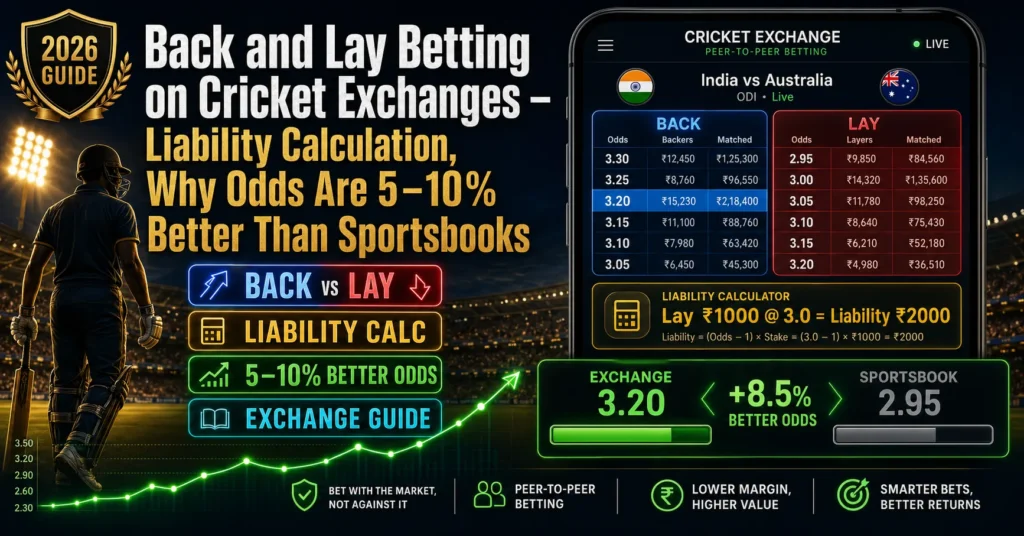
- Your liability — the amount you must pay out if India wins. This is NOT your stake. It is calculated as:
Liability=Backer’s Stake×(Lay Odds−1)\text{Liability} = \text{Backer’s Stake} \times (\text{Lay Odds} – 1)Liability=Backer’s Stake×(Lay Odds−1)
This is the number that surprises new lay bettors. Your liability on a lay bet can significantly exceed the profit you stand to make.
Liability Calculation — Three Worked IPL Examples
Example 1 — Lay Bet on Match Favourite (Low Odds)
Market: India vs West Indies T20. India heavily favoured at 1.35 on TigerExch.
You lay India at 1.35. Backer’s stake accepted: ₹5,000.
Profit if India loses (or match tied):
₹5,000 (backer’s stake) − 2% commission = ₹4,900 net profit
Liability if India wins:
₹5,000×(1.35−1)=₹5,000×0.35=₹1,750 liability₹5,000 \times (1.35 – 1) = ₹5,000 \times 0.35 = ₹1,750 \text{ liability}₹5,000×(1.35−1)=₹5,000×0.35=₹1,750 liability
Summary:
- You risk ₹1,750 to win ₹4,900
- India wins (likely at 1.35) → You lose ₹1,750
- India loses or ties (unlikely at 1.35) → You win ₹4,900
Context: Laying heavy favourites on a cricket exchange carries low liability but low probability of winning. This is a high-risk position despite the small liability number — the favourite wins most of the time. Back lay betting on a cricket exchange at short odds favours cautious lay positions only when the favourite is genuinely overpriced.
Example 2 — Lay Bet on Even-Money Market
Market: MI vs CSK IPL playoff. MI at 2.00 on TigerExch (genuine 50/50 as priced).
You lay MI at 2.00. Backer’s stake accepted: ₹3,000.
Profit if MI loses:
₹3,000 − 2% commission = ₹2,940 net profit
Liability if MI wins:
₹3,000×(2.00−1)=₹3,000×1.00=₹3,000 liability₹3,000 \times (2.00 – 1) = ₹3,000 \times 1.00 = ₹3,000 \text{ liability}₹3,000×(2.00−1)=₹3,000×1.00=₹3,000 liability
Summary:
- You risk ₹3,000 to win ₹2,940
- This is effectively an even-money lay bet — appropriate when you genuinely believe MI’s win probability is below 50%
Context: Even-money lay bets on a cricket exchange are the cleanest expression of the back lay model — risk and reward are approximately equal, and the decision is purely about whether you assess the probability below or above the market’s 50% implied by 2.00 odds.
Example 3 — Lay Bet on Outsider (High Odds)
Market: Afghanistan vs India T20. Afghanistan at 6.50 on TigerExch.
You lay Afghanistan at 6.50. Backer’s stake accepted: ₹1,000.
Profit if Afghanistan loses:
₹1,000 − 2% commission = ₹980 net profit
Liability if Afghanistan wins:
₹1,000×(6.50−1)=₹1,000×5.50=₹5,500 liability₹1,000 \times (6.50 – 1) = ₹1,000 \times 5.50 = ₹5,500 \text{ liability}₹1,000×(6.50−1)=₹1,000×5.50=₹5,500 liability
Summary:
- You risk ₹5,500 to win ₹980
- Afghanistan wins (unlikely but possible) → You lose ₹5,500
- Afghanistan loses (likely) → You win ₹980
Context: This is the lay bet type that causes the most financial damage to unprepared bettors on a cricket exchange. The liability on a high-odds lay bet is massively disproportionate to the potential profit. Laying outsiders at 6.00+ on any cricket exchange should only be done with full understanding of the ₹5,500 liability — not the ₹1,000 “stake” figure.
The golden rule of lay betting on a cricket exchange: Always calculate your liability before confirming any lay bet. Never look only at the backer’s stake. The liability is what you stand to lose.
Why Exchange Odds Beat Sportsbook Odds by 5–10% — The Economics
Back and lay betting on a cricket exchange consistently produces better odds than sportsbooks. Here is the exact mechanism.
The Sportsbook Margin Model
A sportsbook must profit regardless of match outcome. It achieves this by setting odds below true probability on both sides of every market. The gap between the sum of all implied probabilities and 100% is the sportsbook’s margin — typically 8–12% on cricket markets.
Example — India vs Pakistan T20 at a standard sportsbook:
| Outcome | True Probability | Sportsbook Odds | Implied Probability |
| India wins | 55% | 1.68 | 59.5% |
| Pakistan wins | 45% | 2.05 | 48.8% |
| Total | 100% | — | 108.3% |
The 8.3% over-round is the sportsbook’s built-in profit margin — extracted from every bet placed, regardless of outcome.
The Cricket Exchange Commission Model
On a cricket exchange, odds are set by market participants competing to offer the best prices. The platform takes only a 2–3% commission on net winnings. There is no built-in margin on the odds themselves.
Same market on TigerExch cricket exchange:
| Outcome | True Probability | Exchange Odds | Implied Probability |
| India wins | 55% | 1.90 | 52.6% |
| Pakistan wins | 45% | 2.22 | 45.0% |
| Total | 100% | — | ~97.6% (commission-adjusted) |
The implied probability total is below 100% — meaning the odds offered on the cricket exchange are actually above true probability before commission. After 2% commission on winnings, the effective take-out rate drops to approximately 2–3% versus the sportsbook’s 8–12%.
The Financial Impact Over a Season
For a bettor placing 200 bets at ₹500 average stake across an IPL season:
| Platform | Effective Take-Out | Expected Cost Per Season |
| Standard sportsbook | 10% | ₹10,000 |
| Better sportsbook (Laser247) | 5% | ₹5,000 |
| Cricket exchange (TigerExch) | 2.5% | ₹2,500 |
Back lay betting on a cricket exchange saves ₹7,500 per season versus a standard sportsbook on identical activity. This is the financial case for understanding and using cricket exchange betting.
Back Lay Trading — The Advanced Application
Once back and lay betting on a cricket exchange is understood, a more advanced application opens: back lay trading — holding positions on both sides of a market at different prices to lock in profit regardless of outcome.
How Back Lay Trading Works
You back India at 2.00 (pre-match) on TigerExch. India are 45 runs for 0 after the powerplay — performing strongly. India’s price drops to 1.55.
You now lay India at 1.55 — effectively closing your position at a profit.
The maths:
Back bet: ₹2,000 on India at 2.00 → Win ₹2,000 profit if India wins, lose ₹2,000 if India loses.
Lay bet: ₹2,580 against India at 1.55 (sized to balance the positions).
If India wins:
- Back bet profit: ₹2,000
- Lay bet liability: ₹2,580 × (1.55 − 1) = ₹1,419
- Net: ₹2,000 − ₹1,419 = ₹581 profit
If India loses:
- Back bet loss: ₹2,000
- Lay bet profit: ₹2,580 − commission = ₹2,528
- Net: ₹2,528 − ₹2,000 = ₹528 profit
You have locked in approximately ₹550 profit regardless of match result — by backing high and laying low on the same cricket exchange market.
This back lay trading technique is the foundation of professional cricket exchange betting. It converts probability assessment into locked profit by trading the market rather than simply predicting outcomes.
Back Lay Betting Cricket Exchange — Khai Lagai Connection
Indian bettors familiar with khai-lagai terminology will recognise the direct mapping:
| Khai-Lagai Term | Cricket Exchange Term | Meaning |
| Lagai | Back | Betting FOR an outcome |
| Khai | Lay | Betting AGAINST an outcome |
| Session line | Exchange total market | Over/under on runs in a phase |
| Lambi Pari | Innings total market | Full innings over/under |
Back and lay betting on a cricket exchange is the formalised, platform-enabled version of the khai-lagai model that Indian bettors have used for decades. The terminology is different; the concept is identical.
Best Platforms for Back Lay Betting Cricket Exchange in India 2026
Not every Indian cricket betting platform offers genuine back and lay betting on a cricket exchange. Most Indian platforms are sportsbooks — back-only. Here are the verified options.
TigerExch — Best Back Lay Cricket Exchange for Indian Bettors
TigerExch is the only fully verified peer-to-peer cricket exchange in the Indian market offering complete back and lay functionality. Back lay betting on TigerExch covers match winner, session markets, innings totals, and selected fancy markets with documented IPL liquidity.
Back lay cricket exchange features:
- Full back and lay positions on all available markets ✅
- 2–3% commission on net winnings ✅
- IPL liquidity verified (38% volume surge handled) ✅
- Live back lay trading available ✅
- Minimum deposit: ₹200 ✅
- Withdrawal: 45–60 minutes (the trade-off for better odds) ✅
Laser247 — Limited Back Lay Availability
Laser247 offers some exchange-style markets alongside its primary sportsbook offering. Full back and lay betting on a cricket exchange is not the core model — but exchange-adjacent pricing on specific markets makes it the second-best option for bettors who want better odds without a pure exchange interface.
Common Back Lay Betting Mistakes on Cricket Exchanges
Mistake 1: Ignoring liability on lay bets
The most financially damaging mistake in back lay betting on cricket exchanges. New lay bettors focus on the backer’s stake (their potential win) and ignore the liability (their potential loss). Always calculate liability using the formula above before placing any lay bet.
Mistake 2: Laying high-odds outsiders without liability awareness
Laying a team at 7.00 on a cricket exchange to win ₹1,000 means accepting ₹6,000 liability. New back lay cricket exchange bettors do this repeatedly because the ₹1,000 win looks attractive — until the outsider wins once and wipes out six previous profits.
Mistake 3: Treating back lay trading as guaranteed profit
Back lay trading locks in profit when positions are sized correctly. Incorrectly sized lay positions, partially matched bets, or back lay trades placed at unfavourable price gaps can result in losses. Practice the liability and trade sizing calculations before committing real stakes.
Mistake 4: Using a sportsbook for markets available on a cricket exchange
If a market is available on both a sportsbook and a cricket exchange, the exchange almost always offers better odds. Defaulting to a sportsbook because it is familiar costs money on every bet where a cricket exchange alternative exists.
Frequently Asked Questions — back and lay betting cricket exchange
Q1: What is back and lay betting cricket exchange?
Back and lay betting on a cricket exchange means placing bets against other users rather than against a platform. Back betting means betting FOR an outcome — India to win. Lay betting means betting AGAINST an outcome — India to NOT win. The cricket exchange matches back bettors with lay bettors and takes a small commission on winnings. This model produces significantly better odds than sportsbooks.
Q2: What is liability in lay betting on a cricket exchange?
Liability is the amount you stand to lose if your lay bet loses — calculated as: Backer’s Stake × (Lay Odds − 1). For example, laying India at 2.50 with a ₹2,000 backer’s stake creates a liability of ₹2,000 × (2.50 − 1) = ₹3,000. Your liability on a lay bet can significantly exceed your potential profit — always calculate it before confirming.
Q3: Why are cricket exchange odds better than sportsbook odds?
Sportsbooks embed an 8–12% margin into their odds — meaning both sides of every market are priced below true probability. Cricket exchanges take only a 2–3% commission on winnings with no embedded margin in the odds. This produces exchange odds 5–10% better than equivalent sportsbook markets on the same outcome — saving regular bettors thousands of rupees per IPL season.
Q4: Which is the best cricket exchange for Indian bettors in 2026?
TigerExch is the best verified cricket exchange for Indian bettors in 2026 — the only fully peer-to-peer back lay cricket exchange in the verified Indian market with documented IPL liquidity. It offers complete back and lay positions, 2–3% commission, and strong live market liquidity during IPL peak periods.
Q5: What is back lay trading on a cricket exchange?
Back lay trading means holding both a back position and a lay position on the same market at different odds — locking in a profit regardless of outcome. You back India at 2.00 pre-match, then lay India at 1.55 after a strong powerplay. The price difference between your back and lay positions, sized correctly, creates guaranteed profit whichever team wins.
Q6: Is lay betting available on Laser247?
Laser247 offers exchange-adjacent pricing on some markets but is primarily a sportsbook — full lay betting positions as on a dedicated cricket exchange are limited. For complete back and lay betting cricket exchange functionality, TigerExch is the verified choice for Indian bettors.
Q7: How does back lay betting connect to khai lagai?
The connection is direct. Lagai (khai-lagai) = Back (cricket exchange). Khai (khai-lagai) = Lay (cricket exchange). Back lay betting on a cricket exchange is the formalised platform version of the same concept Indian bettors have used in traditional khai-lagai session markets for decades — different terminology, identical underlying model.
Q8: What is the minimum stake for back lay betting on TigerExch?
TigerExch has a ₹200 minimum deposit. Minimum bet sizes on individual back and lay positions vary by market — most match winner and session markets allow minimum stakes from ₹50–₹100 per position. Verify current minimums with TigerExch support for specific markets.
Q9: Can back lay betting on a cricket exchange be done during live matches?
Yes — live back and lay betting on a cricket exchange is one of the most active markets during IPL matches on TigerExch. Match winner odds, session totals, and innings total markets all accept live back and lay positions. Live back lay trading — backing pre-match and laying during the innings as odds move — is the most advanced live betting technique on cricket exchanges.
Q10: What is the difference between a cricket exchange and a sportsbook?
On a sportsbook, the platform is your opponent — it sets odds with a built-in 8–12% margin and profits when you lose. On a cricket exchange, you bet against other users — the platform charges only 2–3% commission on winnings and has no stake in outcomes. Cricket exchanges produce better odds and allow lay betting; sportsbooks are simpler but more expensive for regular bettors over a full season.
Related reading — recent guides on this site
- Sportsbook vs Exchange for Cricket — The two models compared structurally.
- Cricket Market Depth by Format — Where exchange pricing advantages actually show up.