Pre-match cricket betting is about prediction. Live in-play cricket betting is about reaction — and the bettors who react faster, more accurately, and with better structural frameworks consistently outperform those who are simply watching the same match and guessing.
The Indian cricket betting market produces the highest live betting volumes in the world during IPL season. Khai-lagai session lines update ball-by-ball. Lambi pari lines swing by 15–20 runs in a single over during a wicket cluster. Exchange odds on match winner shift by 30–40% in under 60 seconds after a key dismissal. The market is moving constantly — and inside that movement, specific, documentable opportunities repeat across matches and seasons.
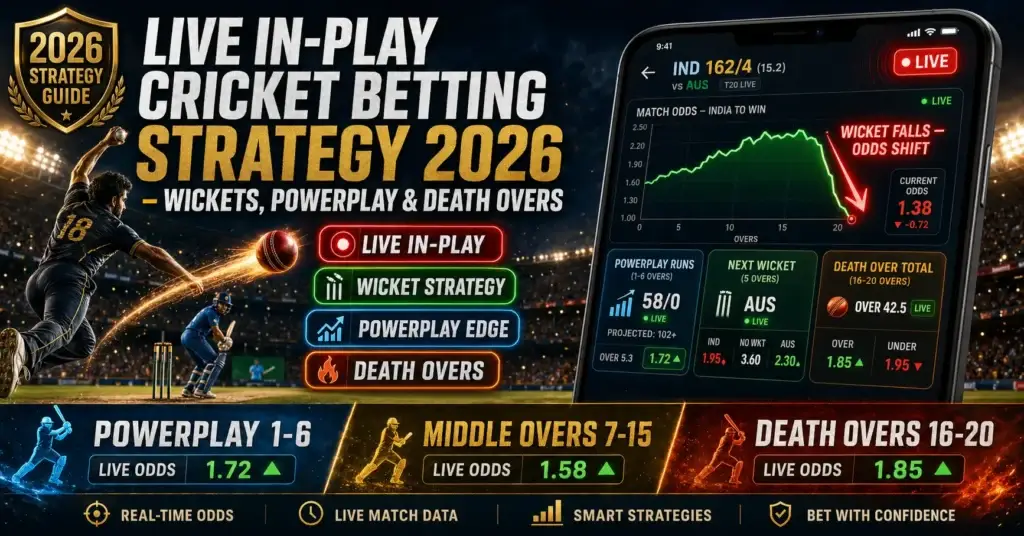
This guide covers seven live in play cricket betting strategy, each documented with IPL examples, clear entry conditions, and honest risk context. These are not tips. They are structured frameworks for identifying specific moments where the live market has mispriced the remaining match probability — and how to act on that mispricing systematically.
Last updated: April 2026
Why Live In Play Cricket Betting Strategy Produces More Opportunity Than Pre-Match
Before the strategies, the structural reason live markets create opportunity — because understanding this prevents you from approaching live betting the wrong way.
Pre-match cricket betting markets are relatively efficient. Bookmakers and exchanges have hours or days to set accurate lines. Large volumes of informed money from professional bettors and algorithmic traders compress mispricings quickly. The edge available to a casual bettor in a pre-match market is thin.
Live markets are structurally less efficient for three specific reasons:
- Speed of information vs speed of line adjustment
When a wicket falls, a boundary is hit, or rain interrupts play — the bookmaker’s algorithmic pricing model must update the line in real time. This process is not instantaneous. There is a 2–8 second window between a match event occurring and the live line fully reflecting its probability impact. Bettors watching the live feed and acting within this window are operating on information the market has not yet fully priced. - Over-correction after dramatic events
Live odds and lines consistently over-correct after high-drama moments — two wickets in two balls, a six off the first ball of a powerplay, a run-out in the final over. The algorithm reacts to the event itself, not to the full context of the remaining match. A team losing two early wickets still has their best batters at numbers 4, 5, and 6. The line drops more than the probabilistic impact of the wickets justifies, creating lagai value for the bettor who evaluates the full batting lineup remaining. - Human psychology amplified by live conditions
In a room, on a phone, watching a last-over thriller — human bettors make emotionally driven decisions at higher frequency than in pre-match planning sessions. The average live betting stake is placed with less deliberation than a pre-match stake. This collective irrationality creates persistent mispricings that systematic bettors can exploit.
The seven strategies below are specifically designed to capture these three structural inefficiencies.
Before You Start — Live In-Play Betting Requirements
Live in-play betting is more demanding than pre-match betting in specific ways. Meeting these requirements before placing a single live bet significantly improves outcomes.
Live match access: You need a live stream or ball-by-ball scoring feed running simultaneously with your betting platform. The JioCinema or Star Sports stream, or ball-by-ball Cricbuzz/ESPNcricinfo — any source that gives you real-time match state. Betting live without a live feed means you are always reacting to events the platform has already priced.
Platform with fast live line updates: Not all platforms update live khai-lagai lines at the same speed. Laser247 and TigerExch have the fastest live line update frequencies based on community documentation. Slower platforms create the illusion of opportunity that has already closed by the time your bet is placed.
Pre-loaded wallet: Live opportunities last seconds to minutes. If your wallet is empty and you need to make a deposit before placing a live bet, the opportunity will be gone before your deposit clears. Maintain a pre-loaded betting wallet during live sessions.
Session budget set in advance: Live betting’s ball-by-ball nature creates the highest frequency loss scenario in cricket betting. Decide your total session budget before the match starts. Divide it into maximum 6–8 live bets. Do not exceed this allocation regardless of match state.
Strategy 1 — React to Early Wickets (The Post-Wicket Lagai Play)
The opportunity: When two or more wickets fall in the first three overs of an innings, live Lambi Pari and session lines drop sharply. This drop consistently overestimates the impact of the wickets — particularly when the dismissed batters are openers and the team’s primary middle-order power hitters remain.
The structural logic: An IPL team’s top-order openers are important, but many of India’s most destructive T20 batting units concentrate their power in positions 4–6. Losing two openers in over 3 removes roughly 25–30% of expected batting contribution, but lines frequently drop 12–18 runs on Lambi Pari — implying a 35–45% reduction in expected scoring. The correction is too large.
Entry conditions for this strategy:
- Two wickets have fallen in overs 1–3
- The dismissed batters are openers or number 3
- The team’s recognised power hitters at 4, 5, and 6 are all still to bat
- The Lambi Pari line has dropped 10+ runs from its pre-match opening level
- No additional wicket has fallen in the over immediately before your entry
Worked IPL 2026 example:
Rajasthan Royals batting first. Pre-match Lambi Pari: 171. Over 2: Buttler caught for 4. Over 3: Samson run out for 1. Two wickets, 18 runs. Line drops to 152.
Remaining batting: Sanju Samson gone, Buttler gone — but Riyan Parag (in exceptional IPL 2026 form), Shimron Hetmyer, Dhruv Jurel, and Ravindra Jadeja all yet to bat. The team has four reliable middle-order contributors untouched.
Line at 152 implies an expected total barely above what RR scores in an average powerplay alone. This is over-corrected.
Action: Lagai (Over 152) for ₹1,000 at 1.85.
Result: RR recover to 167 — Parag scores 54. Lagai wins. Return: ₹1,850 (₹850 profit).
Risk context: This strategy fails when the team has thin batting depth and the dismissed batters were genuinely the primary scoring threats. Always verify remaining batting lineup before entry — do not apply this strategy mechanically without checking who is still to bat.
Strategy 2 — Powerplay Momentum Trade
The opportunity: The powerplay (overs 1–6) sets the tone for the entire innings — and live market participants frequently overweight powerplay performance when projecting full innings totals.
A team scoring 60+ in the powerplay sees their Lambi Pari line shoot to 185–195. A team scoring 35 in the powerplay sees their line collapse to 145–150. Both moves are frequently excessive relative to what the remaining 14 overs can realistically deliver.
The two sides of this strategy:
Side A — Khai after an explosive powerplay: When a team scores 60+ runs in 6 overs with minimal wicket loss, their Lambi Pari line will typically have risen to 185–200. At many IPL venues, sustaining a 10+ runs-per-over pace across 20 overs is extremely rare — the pitch slows down, spinners come on, and middle-order batters at 4–6 are rarely as explosive as specialist T20 openers. Taking khai at the inflated post-powerplay Lambi Pari line is a structural play.
Side B — Lagai after a poor powerplay: When a team scores 32–38 in 6 overs but has lost no wickets, their set openers can accelerate aggressively in overs 7–12 before the spinners become dominant. A below-average powerplay with intact wickets often results in a above-average final total — the line is too low.
Entry conditions for Side A (Khai after explosive powerplay):
- Team has scored 58+ runs in powerplay
- Lambi Pari line has risen above the venue’s historical 90th percentile total
- At least 2 wickets have fallen (reducing finish acceleration)
- Middle-order recognised as less explosive than openers
Entry conditions for Side B (Lagai after suppressed powerplay):
- Team has scored 34–42 runs in powerplay
- No wickets have fallen OR only one wicket
- Team’s best power hitters at 4–5 are still to bat
- Lambi Pari line has dropped below venue historical average
Worked IPL 2026 example (Side A):
KKR batting first at Eden Gardens. Powerplay: 64 runs, 1 wicket. Lambi Pari rises to 196.
Eden Gardens average IPL total: 174. Only 4 matches at Eden have exceeded 195 in last 3 IPL seasons. KKR have 3 recognised power hitters gone or batting by over 6 — middle order is consolidation-focused.
Action: Khai (Under 196) for ₹800 at 1.90.
Result: KKR finish 183 — excellent total but below 196. Khai wins. Return: ₹1,520 (₹720 profit).
Strategy 3 — Middle-Overs Consolidation Read
The opportunity: Overs 7–14 in T20 cricket — the “consolidation phase” — are the most predictable segment of any innings, and therefore the least efficiently priced in live markets that over-react to boundary balls and quiet overs.
During this phase, most IPL teams are rebuilding after powerplay wickets or consolidating a strong powerplay platform. Run rates in this phase are the most stable of any 8-over segment — typically 7.5–9.5 per over for most IPL teams regardless of their powerplay performance.
The strategy: Identify when middle-overs session lines are set significantly above or below the team’s documented middle-overs run rate. The starting point is simple research: check each IPL team’s overs 7–14 average on ESPNcricinfo before the match. When the live line for this phase diverges significantly from historical average without a clear justification, there is a session bet opportunity.
Worked IPL 2026 example:
Mumbai Indians overs 7–14 session line: 76 runs (9.5 runs/over average implied).
MI’s actual overs 7–14 average in IPL 2026: 68.4 runs (8.6 runs/over). No significant batting lineup change from their typical order. The line is set 7.6 runs above MI’s documented middle-overs rate.
Action: Khai (Under 76) for ₹600 at 1.88.
Result: MI score 71 in overs 7–14. Khai wins. Return: ₹1,128 (₹528 profit).
Strategy 4 — Death-Over Volatility Play
The opportunity: Overs 16–20 are the highest-variance segment of any T20 innings. Death over outcomes are genuinely harder to predict than other phases — and this unpredictability means that when a clear structural edge exists, it is frequently larger than in more predictable phases.
Two specific death-over scenarios produce reliable edges:
Scenario A — Key death-over bowler unavailable: When a team’s primary death-over specialist (e.g., Jasprit Bumrah, Mohammed Shami) is not playing or has already bowled their quota, the opposing team’s death-over batting line frequently does not rise to reflect this. Lagai on the batting team’s death-over session is strong structural value.
Scenario B — Power hitters at the crease, 2–3 wickets remaining: When a team reaches over 16 with their best death-over hitters (Hardik Pandya, Rinku Singh, Tim David profile) at the crease and 2–3 wickets in hand, death-over lines frequently underestimate what these specialist finishers can produce. Lagai has structural value.
Worked IPL 2026 example (Scenario A):
CSK facing MI in death overs. Bumrah has bowled his full 4-over quota by over 14. MI death-overs attack in overs 16–20 is Gerald Coetzee, Tilak Varma (part-time), and hardik Pandya.
CSK death-overs session line: 48 runs (9.6 runs/over). CSK’s death-overs average against non-Bumrah attacks this IPL: 56.2 runs. The line has not adjusted for Bumrah’s quota being exhausted.
Action: Lagai (Over 48) for ₹700 at 1.90.
Result: CSK score 59 in death overs. Lagai wins. Return: ₹1,330 (₹630 profit).
Strategy 5 — Innings Break Trade
The opportunity: The innings break — the 20-minute interval between the first and second innings — is one of the most significant live betting windows in any T20 match. Multiple markets update simultaneously as first-innings information is fully known and second-innings projections open.
During the innings break, the following markets become available or update:
- Match winner odds (now fully incorporating first-innings total)
- Second-innings Lambi Pari (chasing team’s expected run rate)
- Powerplay session lines (for the chasing team)
- Toss impact assessment (was the toss winner right to bat or field?)
The specific opportunity: Match winner odds immediately after the innings break frequently contain the largest mispricing of any point in the match — because they are set before pitch deterioration data, dew accumulation status, and chasing team’s momentum are fully incorporated.
Innings break trading framework:
Step 1: Note the first-innings total and compare to venue historical average.
Step 2: Assess pitch deterioration — did the pitch slow down significantly in overs 15–20? A deteriorating pitch heavily favours the team batting first.
Step 3: Check dew status — for evening matches, is dew building on the outfield? Dew significantly eases the chasing team’s task by making the ball harder to grip for bowlers.
Step 4: Compare match winner odds to your assessment. If the market is pricing the chasing team too low given dew, or too high given pitch deterioration, the innings break offers a direct entry point.
Worked IPL 2026 example:
Wankhede Stadium, 7:30 PM match. DC score 168 batting first. At innings break, MI priced at 1.65 to chase (favourite).
Assessment: Wankhede has heavy dew by over 15 in April evening matches (documented fact). Pitch showed minimal deterioration — DC’s spinners struggled to grip by over 18. MI have Rohit Sharma, Suryakumar Yadav, and Hardik Pandya in the chase — their three best T20 run-chasers.
168 at Wankhede with dew is a very gettable target. But 1.65 already prices MI as heavy favourite — there is no lagai value there.
Counter-assessment: DC’s bowling attack features Kuldeep Yadav — a wrist spinner who is specifically effective in dew conditions (unorthodox grip). MI’s chase win probability is genuinely 68–70%, making 1.65 (implying 60.6%) a slight undervalue.
Action: Lagai on MI at 1.65 for ₹1,500.
Result: MI chase 169/4 in 18.2 overs. Lagai wins. Return: ₹2,475 (₹975 profit).
Strategy 6 — Dew Factor (Chasing Team Structural Advantage)
The opportunity: Dew is the single most reliable structural variable in evening T20 cricket in India — and it is consistently under-incorporated in pre-match and early-innings live lines.
When significant dew accumulates on the outfield during an evening T20 match, the ball becomes wet and heavier by overs 14–20. This makes it significantly harder for bowlers to:
- Grip the ball for pace deliveries
- Generate swing or seam movement
- Execute slower balls and cutters cleanly
The net effect: batting in the second innings in dew-heavy conditions is demonstrably easier than batting in the first innings. Multiple IPL seasons of data consistently show that second-innings teams chase successfully at a meaningfully higher rate than first-innings teams defend at dew-heavy venues.
High-dew venues in IPL calendar:
- Wankhede Stadium, Mumbai (highest dew probability — coastal humidity)
- Eden Gardens, Kolkata (April-May evening matches)
- DY Patil Stadium, Navi Mumbai
- Brabourne Stadium, Mumbai
Low-dew venues (dew factor minimal):
- MA Chidambaram Stadium, Chennai (sea breeze disperses dew)
- M Chinnaswamy Stadium, Bengaluru (high altitude, drier evening air)
- Sawai Mansingh Stadium, Jaipur (dry Rajasthan air)
Dew factor betting application:
When a match is played at a high-dew venue in an evening slot (6:30 PM+ start), and the toss-winning captain chooses to field first (sending the opposition to bat) — this is the ideal setup for a second-innings lagai play.
The toss winner has already told you they expect dew to assist chasing. The pre-match odds should reflect this — if they do not, there is direct value.
Entry point: After first innings overs 14–16, when dew is visibly building (commentators frequently mention it), take the chasing team on match winner if odds have not yet fully adjusted.
Strategy 7 — Pitch-Based Session Reads
The opportunity: Pitch conditions in India are not uniform across venues or even across different times of the season. A Chepauk pitch in April plays completely differently from a Wankhede pitch in the same week. Pitch reports are publicly available — and they are frequently not fully incorporated into session lines.
The two primary pitch patterns relevant to session betting:
Dry, turning pitch (Chennai, Ahmedabad, Lucknow late season):
- Spinners become increasingly effective from overs 7–10 onward
- Middle-overs run rates are significantly suppressed
- Total innings averages are 10–15 runs below “neutral venue” norms
- Application: Khai on middle-overs session lines set at neutral-venue averages, Khai on Lambi Pari lines above historical average for that specific venue
Flat, pace-friendly pitch (Wankhede, Eden Gardens, DY Patil):
- Pacers do not get purchase — batters play through the line more freely
- Death-over run rates are elevated compared to turning tracks
- Total innings averages are 8–12 runs above “neutral venue” norms
- Application: Lagai on death-overs session lines, Lagai on Lambi Pari lines near historical average
How to access pitch data before each IPL match:
ESPNcricinfo publishes a pre-match pitch report for every IPL fixture — typically 2–3 hours before start. The report includes pitch colour (dry/green/damp), historical average score at venue, and curator comments on expected behaviour. This is free, publicly available, and takes four minutes to read.
Cross-reference the pitch report against the opening session lines on your platform. When the lines are set at national averages rather than venue-specific averages, the discrepancy is your opportunity.
Live In-Play Betting — Platform Considerations
Live in-play betting places specific demands on your betting platform that standard pre-match betting does not. Here is what matters most.
Live Line Update Frequency
On Laser247 and TigerExch, khai-lagai lines update every 2–4 seconds during live IPL matches — fast enough to capture post-event windows. On slower platforms, lines may update every 8–15 seconds, meaning the profitable window after a wicket or boundary has often closed before your bet is confirmed.
Bet Acceptance Speed
On sportsbooks, your live bet is accepted (or rejected) by the platform’s algorithm. During high-activity moments — immediately after a wicket — platforms frequently suspend markets for 10–30 seconds while repricing. Understanding when markets suspend and being ready immediately when they reopen is a live betting skill in itself.
On exchanges like TigerExch, your live bet needs to be matched by another user. During highly active markets (IPL playoff matches), matching is fast. During quieter periods or on thinner markets, you may be partially matched — your bet fills only to the available liquidity.
Recommended Platform for Live In-Play Betting And Live In Play Cricket Betting Strategy
Laser247 for sportsbook-style live khai-lagai — fastest line updates, immediate bet acceptance, full session market range.
TigerExch for exchange-style live betting — best odds quality, back-lay capability on live markets, strongest liquidity during IPL peaks.
Many experienced live bettors maintain accounts on both — using Laser247 for session and fancy markets where speed matters, TigerExch for match winner and exchange markets where odds quality matters more than execution speed.
Live Betting Discipline — The Rules That Protect Your Bankroll
Live in-play betting is the environment where bankrolls disappear fastest. The following discipline rules are non-negotiable.
Rule 1: Set your live session budget before the match starts — not during it.
Deciding how much you will spend on live bets while watching an exciting match is the worst possible decision environment. Fix the number beforehand. When it is gone, the session is over.
Rule 2: Maximum 6–8 live bets per match.
More than this and you are reacting to every moment rather than to specific strategy entry conditions. Frequency is the enemy of live betting discipline.
Rule 3: Never increase stake size after a loss.
The temptation to double up after a wrong-direction line call is the single most common live betting bankroll destruction mechanism. Each bet is sized the same regardless of the previous bet’s outcome.
Rule 4: Write down your entry condition before placing each live bet.
This sounds laborious. It takes 10 seconds. “Early wickets, lineup intact, lagai at depressed line.” Writing it forces you to verify the conditions are actually met rather than bet on feel.
Rule 5: Cash out or partially exit when the original entry condition is no longer valid.
If you took lagai after two early wickets and a third wicket falls immediately, your original entry condition has changed materially. The correct response is to exit or reduce — not to hold and hope.
Frequently Asked Questions — Live In Play Cricket Betting Strategy
Q1: What is live in-play cricket betting?
Live in-play cricket betting refers to bets placed after a match has started — on continuously updating markets including khai-lagai session lines, Lambi Pari innings totals, match winner odds, and ball-by-ball propositions. Markets update in real time as match events occur. Live betting offers more opportunities than pre-match betting because live odds and lines are less efficiently priced.
Q2: Which strategy is best for beginners doing live cricket betting?
The post-wicket lagai play (Strategy 1) is the most accessible starting point — it has clear entry conditions, a logical foundation, and applies to almost every IPL match. Begin by paper-trading it (tracking without real money) for 5–10 matches to verify you understand the entry conditions before applying real stakes.
Q3: How fast do live cricket betting lines update?
On the fastest platforms (Laser247, TigerExch), live khai-lagai lines update every 2–4 seconds during active IPL matches. On slower platforms, updates run every 8–15 seconds. The update speed directly determines whether the post-event pricing window is accessible to you — slower platforms close the window before your bet is placed.
Q4: What is the innings break trading strategy?
The innings break trading strategy involves placing bets during the 20-minute interval between innings — when first-innings totals are known, pitch deterioration is assessable, and dew status is visible, but match winner odds have not yet fully incorporated all of this information. The innings break frequently produces the largest single mispricing window in any T20 match.
Q5: How does dew affect live cricket betting?
Dew accumulates on outfields during evening T20 matches at specific humid Indian venues — particularly Wankhede (Mumbai), Eden Gardens (Kolkata), and DY Patil (Navi Mumbai). Dew makes the ball wet and harder to grip, significantly suppressing bowling effectiveness in later overs. Second-innings batting teams benefit materially from dew — and pre-match and early-innings live lines frequently undervalue this structural chasing team advantage.
Q6: What markets are available for live in-play cricket betting?
Live in-play cricket markets include: match winner (continuously updating), Lambi Pari (full innings total, ball-by-ball), powerplay session over/under, middle-overs session over/under, death-overs session over/under, next over runs, fall of next wicket, Yes/No propositions, and updated fancy markets (top batsman, total sixes). All use the khai-lagai model on Indian platforms.
Q7: How much should I bet on live cricket markets?
Live betting stakes should be pre-planned as part of your total session budget — set before the match starts. A common framework: divide your session budget into 6–8 equal units. One unit per live bet. No unit should exceed 5% of your total cricket betting bankroll. Never increase unit size to chase losses.
Q8: Is live betting available on TigerExch?
Yes. TigerExch offers full live exchange betting on all available markets — match winner, session markets, and fancy markets with both back and lay positions available. TigerExch’s exchange model provides the best live odds quality of any Indian platform, with the trade-off of 45–60 minute withdrawal times.
Q9: What is the post-wicket lagai play?
The post-wicket lagai play is Strategy 1 in this guide — taking the lagai (over) position on a Lambi Pari or session line immediately after two or more early wickets, when the line has dropped more than the probability impact of the wickets justifies. It works because line algorithms over-correct for dramatic events, particularly when the dismissed batters are openers and the team’s primary middle-order threats remain.
Q10: Which platforms are best for live in-play cricket betting in India?
Laser247 offers the fastest live khai-lagai line updates and immediate bet acceptance — best for session and fancy live markets. TigerExch offers the best live odds quality through its exchange model — best for match winner and back-lay live positions. Maintaining accounts on both covers the full range of live betting opportunities during IPL 2026.
Related reading — recent guides on this site
- Cricket Market Depth by Format — What in-play liquidity looks like across T20, ODI and Test.
- Where the 15-Minute Payout Promise Holds — What happens to withdrawals during peak in-play windows.