Walk into any serious cricket betting conversation in India — on WhatsApp, on Telegram, at a local gathering during IPL — and within five minutes you will hear the words khai, lagai, lambi pari, and session line. These are not slang terms. They are the precise vocabulary of a betting system that has evolved organically within Indian cricket culture over decades and now forms the foundation of how millions of Indian bettors engage with the game.
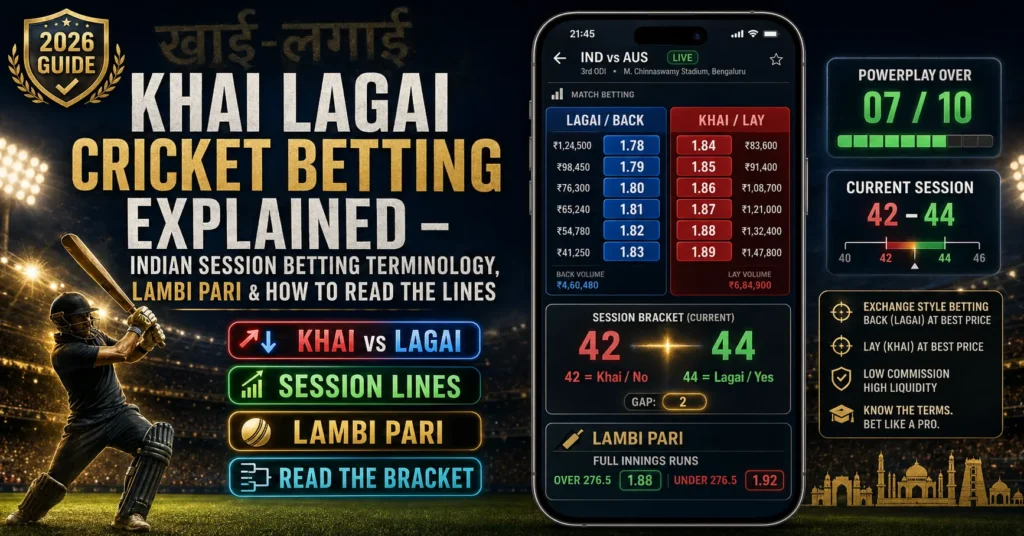
The problem is that almost no platform explains them clearly. International betting guides ignore khai-lagai entirely, but this post khai lagai cricket betting explained
Indian platforms assume you already know. New bettors either figure it out slowly through expensive mistakes or avoid the markets altogether.
This guide fixes that. Khai and lagai explained from scratch. Lambi pari and how to read innings total lines. Yes/No session markets with worked rupee examples. How Indian bookmakers set session lines and where the edges exist. Everything you need to use these markets confidently, explained in plain language.
Last updated: April 2026
The Origin of Khai-Lagai in Indian Cricket Betting
Khai-lagai predates online cricket betting by several decades. The terminology originated in the street betting networks — locally called “satta” markets — that ran alongside domestic and international cricket in India long before any regulated or online platform existed.
In these traditional markets, a local bookmaker would offer a line on a session outcome. Bettors could either take the “lagai” side — backing the event to happen — or take the “khai” side — backing against it. The two sides of every market were always available simultaneously, with the bookmaker adjusting the line rather than the odds to balance action.
This line-movement model — where the number moves rather than the price — is fundamentally different from the odds-movement model used by international sportsbooks. It produces a different betting experience, different opportunities, and different risks. Understanding this structural difference is the single most important conceptual foundation for making sense of khai-lagai markets.
When online cricket betting platforms emerged for the Indian market, they built their session betting products directly on the khai-lagai model because that was what Indian bettors already understood. Today, every major Indian platform — Laser247, TigerExch, LemonBook, Cricbet99, Lotus365 — offers khai-lagai style session markets alongside their international-format odds markets.
Khai and Lagai — The Core Meaning
These two words are the entire foundation of Indian session betting. Every other concept builds from them.
Lagai — Back (For)
Lagai means backing something to happen. You are on the “for” side of a market.
If the session line is set at India scoring 45–47 runs in the powerplay and you take the lagai position, you are betting that India WILL score 45 or more runs in that powerplay. You win if India meets or exceeds the line. You lose if India scores fewer.
Direct international equivalent: A standard “back” bet on an exchange, or an “over” bet on a total in sportsbook terminology.
Khai — Lay (Against)
Khai means betting against something happening. You are on the “against” side of a market.
In the same powerplay example, taking the khai position means you are betting that India will score FEWER than 45 runs. You win if India falls short of the line. You lose if India meets or exceeds it.
Direct international equivalent: A “lay” bet on an exchange, or an “under” bet on a total in sportsbook terminology.
The Memory Anchor
The simplest way to remember the distinction permanently:
Lagai = Lagao = Place your bet FOR it (you are placing money on the outcome)
Khai = Khaana = Eat the stake against it (you are consuming the opposing bettor’s stake)
This linguistic root is not academically verified — it is a memory device used within Indian betting communities. But it works. Thousands of Indian bettors who struggled with the distinction have locked it in using exactly this anchor.
How Session Lines Work — The Line Movement Model
This is where khai-lagai markets differ most fundamentally from standard sportsbook betting — and where new bettors get the most confused.
Fixed Odds vs Moving Lines
International sportsbook model: The bookmaker sets fixed odds (e.g., India to win at 1.85) and adjusts those odds as money comes in. The line (the outcome being bet on) stays the same; the price changes.
Khai-lagai model: The bookmaker sets a session line (e.g., Powerplay runs: 45-47) and adjusts the LINE NUMBER as money comes in, while keeping the price approximately fixed. Both khai and lagai pay at near-even money; what changes is which number you are backing or fading.
Reading a Session Line — The Three-Number Format
Session lines on Indian platforms are typically displayed in a three-number format:
Example: 45–47–No
| Number/Word | Meaning |
| 45 | Lagai wins if runs scored ≥ 45 |
| 47 | Khai wins if runs scored ≤ 47 |
| No | Current market recommendation (No = Khai is favoured) |
Wait — that looks contradictory. If lagai wins at 45+ and khai wins at 47 or fewer, what happens when the score lands between 45 and 47?
The answer: the middle range (45, 46, 47) is the bookmaker’s margin zone — the equivalent of a spread in sports betting. If the innings ends with the score inside this range, both sides push (stake returned, no win or loss). The bookmaker profits by setting the range wide enough that action on both sides slightly exceeds the push zone.
Simplified Two-Number Format
On many platforms and in casual speech, the three-number format is compressed to a single line number — the midpoint:
“Powerplay line: 46”
In this compressed format:
- Lagai (Over/For): You win if the powerplay produces more than 46 runs
- Khai (Under/Against): You win if the powerplay produces fewer than 46 runs
- Exactly 46: Push — stakes returned on most platforms (verify per platform)
Lambi Pari — The Full Innings Total Market
Lambi Pari literally translates as “long bet” or “long game” — it refers to the full innings runs total market, as distinct from individual phase (powerplay, middle, death) markets.
A Lambi Pari market asks one question: How many runs will this batting team score in their complete innings?
How Lambi Pari Lines Are Set
The platform sets a Lambi Pari line based on:
- Team batting strength and current form
- Opposition bowling attack quality
- Ground and pitch conditions
- Weather (especially dew factor for second innings)
- Recent innings totals at the venue
Example Lambi Pari market:
Mumbai Indians batting first at Wankhede Stadium. Lambi Pari line: 172.
| Position | Meaning | Win Condition |
| Lagai (Over) | MI will score 172+ runs | MI finish ≥ 172 |
| Khai (Under) | MI will score under 172 runs | MI finish < 172 |
You take Lagai (Over 172) for ₹1,000 at even money (1.90 odds).
- MI score 185 → ₹1,900 return (₹900 profit)
- MI score 168 → ₹1,000 lost
- MI score exactly 172 → Varies by platform rule — typically push
Live Lambi Pari — How the Line Moves During an Innings
Lambi Pari is one of the most actively traded live markets in Indian cricket betting because the line moves dramatically in response to real-time match events. This is where the market becomes genuinely interesting for experienced bettors.
Live Lambi Pari line movement example:
Pre-match Lambi Pari line: 168. MI batting first.
| Match Moment | Line Movement | Reason |
| Over 1: 12 runs, 0 wickets | 168 → 174 | Explosive start, line rises |
| Over 3: 2 wickets in 2 balls | 174 → 161 | Wicket cluster, line drops sharply |
| Over 6 (powerplay end): 52 runs, 2 wickets | 161 → 167 | Solid recovery, moderate upward move |
| Over 10: 95 runs, 3 wickets | 167 → 172 | On track for good total |
| Over 15: 138 runs, 5 wickets | 172 → 169 | Mid-innings wobble, slight drop |
| Over 18: Suryakumar in, 158 runs | 169 → 178 | Power hitter in, final-over acceleration priced in |
| Final score: 181 | Line at over 18: 178 | Lagai wins for bettors who took 178+ in last 2 overs |
The opportunity for live Lambi Pari bettors: The line overreacts to wickets (drops too far) and underreacts to set batsmen (rises too slowly when an established batsman is well-set). Bettors who follow the match closely and understand innings trajectory can find lagai or khai value at specific moments where the line has moved out of proportion with the actual remaining innings probability.
Yes/No Session Markets — Explained
Yes/No markets are the most straightforward expression of khai-lagai betting. Instead of a numerical line, the market frames a simple question with a binary answer.
How Yes/No Markets Work
Format: The platform states a proposition. You bet Yes (lagai — it will happen) or No (khai — it will not happen).
Example Yes/No markets active during an IPL match:
| Proposition | Yes (Lagai) | No (Khai) |
| “Will India score 50+ runs in the powerplay?” | Bet FOR India scoring 50+ | Bet AGAINST India scoring 50+ |
| “Will the 8th over produce 10+ runs?” | Bet FOR 10+ runs in over 8 | Bet AGAINST 10+ runs |
| “Will there be a wicket in the next 3 overs?” | Bet FOR a wicket | Bet AGAINST a wicket |
| “Will the total reach 200?” | Bet FOR 200+ total | Bet AGAINST 200+ |
Yes/No markets often carry slightly different odds on each side — unlike the near-even money of session line markets — because the proposition is deliberately framed asymmetrically. A proposition set at “Will India score 80+ in the powerplay?” has heavily odds-on No and a juicy Yes price. The value in Yes/No markets lies in finding propositions where the framing creates a mispricing relative to actual probability.
Worked Yes/No Example with Rupee Numbers
Market: “Will CSK score 45+ runs in the powerplay?” (playing at MA Chidambaram Stadium Chennai, known for slow surface)
Odds: Yes (Lagai) at 2.20 | No (Khai) at 1.70
Analysis: MA Chidambaram historically produces powerplay scores of 38–44 for most teams. CSK’s powerplay average this IPL season is 41.3. But today’s playing XI features Ruturaj Gaikwad in exceptional form (3 consecutive 30+ powerplay contributions). The Yes price at 2.20 is generous given Gaikwad’s current impact.
Decision: Lagai (Yes) ₹500 at 2.20
- CSK score 47 in powerplay → ₹1,100 return (₹600 profit)
- CSK score 43 in powerplay → ₹500 lost
How Indian Bookmakers Set Khai-Lagai Lines — And Where the Edges Are
Understanding how lines are constructed gives you a structural framework for finding value — rather than randomly picking sides.
The Line-Setting Process
Indian cricket bookmakers set initial session lines using a combination of:
- Historical ground averages
Every IPL venue has well-documented powerplay, middle, and death over averages across multiple seasons. Wankhede’s powerplay average, Chepauk’s total innings average, Eden Gardens’ evening dew impact — these are the foundation numbers. - Team-specific adjustments
The historical ground average is adjusted up or down based on the specific teams batting and bowling in today’s match. A team with three specialist powerplay hitters shifts the line upward; a strong death-over bowling attack shifts it downward. - Conditions factors
Pitch report (dry/damp, spin-friendly), weather (dew probability in evening matches, overcast for swing), and toss result all generate further adjustments to the opening line. - Market balancing
Once the line is live, the bookmaker adjusts it based on where the money is coming in — moving the line toward khai if too much lagai money arrives, and vice versa. This is the same as how a line moves in Asian Handicap markets.
Where Edges Exist for Informed Bettors
Edge 1: Line overreaction to early wickets
When two wickets fall in the first three overs, Lambi Pari lines and death-over lines drop significantly — often more than the probabilistic impact of the wickets justifies. If a team loses their number 3 and 4 to a short-pitch trap early but still has their most dangerous middle-order batters intact, the line correction is frequently excessive. Taking lagai at the depressed post-wicket line is a documented value play.
Edge 2: Venue ground average vs current line discrepancy
Bookmakers sometimes set opening lines that diverge from ground averages without an obvious justification. Checking the venue’s published powerplay or total innings average against today’s opening line takes two minutes on ESPNcricinfo and occasionally reveals a line sitting 4–6 runs above or below the historical norm with no obvious justification.
Edge 3: Dew factor — evening matches at specific venues
Dew dramatically affects evening T20 matches at venues with high humidity — Wankhede in Mumbai, Eden Gardens in Kolkata during April-May. Bowling becomes significantly easier for the second innings team chasing. Khai on the first-innings Lambi Pari is a consistent structural play at dew-heavy venues when the toss-winning captain chooses to field first.
Edge 4: Death-over specialist unavailable
If a team’s primary death-over pacer is resting or injured, the death-over session line may not have been adjusted sufficiently downward by the bookmaker’s opening line. This creates lagai value on the opposing team’s death-over batting session.
⚠️ Important caveat: These are structural patterns documented from community research and analysis — not guaranteed outcomes. Cricket is highly variable and edges are probabilistic, not certain. No session bet, however well-researched, is a sure thing.
Khai-Lagai on Exchanges vs Sportsbooks — The Key Difference
The khai-lagai model operates differently depending on whether you are on a sportsbook or an exchange.
On a Standard Sportsbook (Laser247, LemonBook, Cricbet99)
The platform acts as bookmaker. It sets the line. You take either khai or lagai against the platform. Odds are fixed at near-even money on both sides. The platform’s profit comes from the spread between lagai and khai line numbers (the push zone described earlier).
Advantage: Simple. No need to find a counterparty. Your bet is filled immediately.
Limitation: You are always betting against the house at the platform’s set line.
On an Exchange (TigerExch)
You bet against other users. The platform matches lagai bettors with khai bettors. Commission charged on winnings. The line moves based on where market participants are willing to trade.
Advantage: You can lay (khai) at any level you choose — not just at the platform’s set line. You can back (lagai) at a better price if the market is offering it. True price discovery between users.
Limitation: You need to find a counterparty. In thin markets, your bet may be partially or fully unmatched.
For most Indian khai-lagai bettors, sportsbooks are the primary channel because matching is instant and guaranteed. Exchange khai-lagai is for more advanced bettors comfortable with the matching and liability mechanics
Khai-Lagai Quick Reference — All Key Terms
| Hindi Term | Meaning | International Equivalent |
| Lagai | Back / For | Back bet / Over |
| Khai | Lay / Against | Lay bet / Under |
| Lambi Pari | Full innings total market | Match total / Innings over-under |
| Session line | Runs total line for a phase | Phase total line |
| Yes | Lagai on a Yes/No market | Over / For |
| No | Khai on a Yes/No market | Under / Against |
| Line | The numerical total being backed or faded | Spread / Total line |
| Push | Score falls within the push zone — stakes returned | Push / Void |
| Satta | Informal term for cricket betting market generally | N/A |
| Rate | The current line price / odds | Odds / Price |
Frequently Asked Questions — khai lagai cricket betting explained
Q1: What does khai lagai mean in cricket betting?
Khai lagai is the traditional Indian cricket betting terminology for the two sides of a session or proposition market. Lagai means backing something to happen (the “for” side — equivalent to “back” or “over” in international betting). Khai means betting against something happening (the “against” side — equivalent to “lay” or “under”). Together they form the foundation of Indian session and fancy market betting.
Q2: What is lambi pari in cricket betting?
Lambi pari is the full innings runs total market in khai-lagai betting — literally “long bet.” A lambi pari market sets a line on how many runs a batting team will score in their complete innings. You take lagai (over) to back the team scoring above the line or khai (under) to back them falling short. Lambi pari is one of the most actively traded live markets during IPL matches.
Q3: How do you read a khai lagai session line?
A session line is typically displayed in a three-number format — for example 45–47–No. The first number (45) is the lagai win level (you win if runs scored reach 45 or above). The second number (47) is the khai win level (you win if runs scored stay at 47 or below). The middle zone (45–47) is the push range where stakes are returned. The third word (No/Yes) indicates which side the current market leans toward.
Q4: What is the difference between session betting and lambi pari?
Session betting covers runs totals for specific phases of the innings — powerplay (overs 1–6), middle overs (7–15), and death overs (16–20). Lambi pari covers the complete innings total across all overs. Session bets settle at the end of their specific phase; lambi pari settles at the end of the full innings. Both use the khai-lagai model.
Q5: Is khai lagai available on online cricket betting platforms?
Yes — all major Indian cricket betting platforms offer khai-lagai style session markets. Laser247, TigerExch, LemonBook, Cricbet99, and Lotus365 all feature powerplay session, middle-overs session, death-overs session, and lambi pari markets using the khai-lagai line model. TigerExch offers exchange-style khai-lagai where users trade against each other rather than against the platform.
Q6: What is a Yes/No market in cricket betting?
A Yes/No market is a simplified khai-lagai proposition — the platform states a specific event (e.g., “Will India score 50+ runs in the powerplay?”) and you bet Yes (lagai — it will happen) or No (khai — it will not happen). Yes/No markets often carry unequal odds on each side depending on how the proposition is framed. They settle immediately when the specified event either occurs or becomes impossible.
Q7: How do bookmakers set khai lagai session lines?
Indian bookmakers set session lines using historical ground averages for the venue, team-specific batting and bowling adjustments, current conditions (pitch, weather, dew), toss result, and real-time market balancing. Once the line is live, it moves in response to betting action — shifting toward khai if heavy lagai money arrives, toward lagai if heavy khai money arrives. This line movement is the primary mechanism for market balance.
Q8: Where is the edge in khai lagai betting?
Documented structural edges include: line overreaction after early wickets (line drops more than probability justifies — lagai value on recovery), venue average discrepancy (line set above or below documented ground average without justification), dew factor at evening matches (khai on first-innings lambi pari at dew-heavy venues when side fields first), and death-over specialist unavailability (lagai on batting team’s death overs if key opposing bowler is absent).
Q9: Can khai lagai bets be placed on live matches?
Yes — live khai-lagai markets are among the most actively traded in Indian cricket betting, especially during IPL. Live lambi pari lines update ball-by-ball. Live session markets (next over runs, current phase over/under) open and settle within the match. Live Yes/No propositions update based on match state. The line movement during live matches creates the most dynamic trading opportunities in Indian cricket betting.
Q10: What platforms offer the best khai lagai session markets for IPL 2026?
Laser247 offers comprehensive khai-lagai session markets with fast line updates and quick bet settlement. TigerExch offers exchange-model khai-lagai with the best odds quality but slower withdrawal. LemonBook offers full session market coverage with real-time lines. For pure khai-lagai volume and variety during IPL, Laser247 and Lotus365 have the widest session market menus. See the full platform comparison:
⚠️ Responsible Gaming: Khai-lagai session markets settle quickly and update ball-by-ball during live matches — this creates a high-frequency environment that can compress your session budget rapidly if stakes are not carefully managed.
Related reading — recent guides on this site
- Colour Prediction vs Cricket Fancy Bets — Two fast products, fundamentally different maths.
- Cricket Market Depth by Format — Where session and fancy markets sit on the depth curve.