Every cricket betting ID in India operates on one of two structural models: agent based vs direct exchange cricket id. Most Indian bettors have used one or both without fully understanding what the structural difference means for their money — specifically, who controls their funds, what happens if something goes wrong, and which model exposes them to more risk.
The agent-based vs direct exchange cricket ID distinction is not a minor operational detail. It is the single most important structural safety factor when choosing a cricket betting platform in India. Mahadev Book, Reddy Book, and the majority of WhatsApp-circulated cricket ID operators use the agent-based model. Laser247, TigerExch, LemonBook, and Cricbet99 use the direct model.
This guide documents the complete risk profile of both models — how each works mechanically, where the risk lives in each structure, the specific ways agent-based cricket ID fraud has played out in India, and a clear framework for deciding which model is appropriate based on your situation.
Last updated: April 2026
The Two Models — A Clear Definition (Agent based vs direct exchange cricket id)
The Agent-Based Cricket ID Model
In an agent-based cricket ID model, your betting account is a sub-account sitting beneath an agent’s master account on the platform. You do not have a direct relationship with the platform itself — your entire relationship is with the agent.
Here is how the structure works:
- The platform hierarchy:
Platform → Master Account (Agent) → Sub-Accounts (Individual Bettors)
The agent holds the master account. You hold a sub-account beneath it. The platform recognises only the master account — it does not know you exist as an individual user.
- Deposits and withdrawals go through the agent:
You want to deposit ₹5,000. You send ₹5,000 to the agent via UPI. The agent credits your sub-account balance. You want to withdraw ₹7,000. You request it from the agent via WhatsApp. The agent sends you ₹7,000 from the master account — if they choose to. - Your credentials are agent-controlled:
Your username, password, and account access are created and controlled by the agent. The agent can restrict, suspend, or close your sub-account at any time. The platform has no record of your individual existence to appeal to.
Who uses the agent-based cricket ID model:
Mahadev Book (the largest agent-based operator in India before its 2023 enforcement action), Reddy Book, and the majority of WhatsApp-based cricket ID providers operating in local and regional networks across India. If a cricket ID provider communicated primarily via WhatsApp and offered you a “master ID” to manage others, it was agent-based.
The Direct Exchange Cricket ID Model
In a direct exchange cricket ID model, you have an individual account directly with the platform. There is no agent in the chain between you and the platform.
- The account hierarchy:
Platform → Your Individual Account
You are a direct platform user. The platform recognises your credentials, your balance, and your transaction history independently.
- Deposits and withdrawals are self-managed:
You deposit directly to the platform using UPI, IMPS, or crypto. The platform credits your account automatically. You initiate withdrawals directly on the platform dashboard. The funds move from the platform to your UPI or wallet — no human agent involved. - Your credentials are yours:
Your username and password are created by you or issued directly to you by the platform. Only you (and platform administration) can access your account. No agent can restrict, suspend, or close your account.
Direct exchange cricket ID platforms in the verified Indian market:
Laser247, TigerExch, LemonBook, Cricbet99, Lotus365, JioFairPlay, AmiriBook — all operate on the direct model.
The Core Risk Difference — Who Controls Your Money
This is the fundamental question that the agent-based vs direct exchange cricket ID distinction answers. And the answer has significant financial consequences.
Agent-Based Model: The Agent Controls Your Funds
In an agent-based cricket ID model, your balance does not technically belong to you until the agent releases it. It sits in the master account — which the agent owns and controls. When you request a withdrawal, you are requesting the agent to voluntarily transfer funds from their account to yours.
This creates a single point of failure and fraud risk: the agent.
If the agent:
- Disappears (stops responding to WhatsApp)
- Is arrested (law enforcement action)
- Decides to keep your balance
- Dies unexpectedly
- Loses their own master account access
- Runs out of liquidity in their master account
…your sub-account balance disappears with them. You have no direct recourse to the platform. You have no independent record of your balance with the platform. Your only documentation is WhatsApp messages with the agent — which is insufficient for any formal recovery process.
Direct Exchange Model: You Control Your Funds
In a direct exchange cricket ID model, your balance belongs to your individual account on the platform. You initiate withdrawals yourself. No agent can intercept, delay, or withhold your funds.
The risk in the direct model is the platform itself — if the platform goes offline, is shut down, or exits the market, your balance is at risk. But this is a materially different and generally lower-frequency risk than the agent disappearance risk, because:
- Established direct platforms (Laser247, TigerExch) have multi-year track records
- Platform exit is typically accompanied by warning signs visible to the community
- Platform-level exits affect all users equally and generate immediate community documentation
Agent disappearances, by contrast, are individual events affecting only that agent’s sub-account holders — and they frequently happen with no warning at all.
Agent-Based Cricket ID Fraud — Documented Patterns in India
The risk of agent-based cricket ID models is not theoretical. Multiple documented fraud patterns have played out at scale in India — particularly accelerating post-PROGA 2025 as enforcement pressure increased on agent-based operators.
Pattern 1 — The Slow Withdrawal Delay
The most common agent-based cricket ID fraud. The agent begins delaying withdrawal requests — first by hours, then by days. Excuses accumulate: “UPI maintenance,” “festival banking holiday,” “platform issue.” Meanwhile, bettors continue depositing, believing the delay is temporary. Eventually the agent stops responding entirely.
Why it works: Bettors are reluctant to escalate publicly while hoping for resolution. The delay gives the agent time to extract maximum deposits before disappearing.
Protection: Any agent-based cricket ID provider who delays withdrawal beyond 24 hours without a specific, verifiable platform explanation should be treated as a fraud signal. Stop depositing immediately.
Pattern 2 — The Enforcement Disappearance
When Indian law enforcement acts on a cricket betting network — which has happened repeatedly, with Mahadev Book being the most high-profile example — the agents in that network frequently disappear overnight with all sub-account balances intact. Individual sub-account holders have no platform-level recourse because the platform itself may be shut down as part of the enforcement action.
Why it is uniquely damaging: Unlike a simple agent fraud, an enforcement-related disappearance affects hundreds or thousands of sub-account holders simultaneously — and recovery through any legal channel is essentially impossible because the activity itself operated in a legal grey area.
Pattern 3 — The Fake Agent Scam
A fraudster poses as an agent for a known legitimate platform — Laser247, Cricbet99, TigerExch. They claim to offer sub-accounts under a master ID. Bettors send deposits via UPI. The fake agent creates functional-looking fake credentials (or simply takes deposits without providing anything). After collecting deposits from multiple victims, they disappear.
Why it targets the agent model: This fraud is only possible because the agent model normalises the expectation of sending money to a human intermediary rather than directly to a platform. Bettors accustomed to the agent model do not question sending ₹5,000 to an unknown UPI ID.
Protection: Laser247, TigerExch, and LemonBook do not operate through agents. If anyone offers you a sub-account or master ID for these platforms, it is a scam. These are direct-model platforms — you register directly with the platform, not through any intermediary.
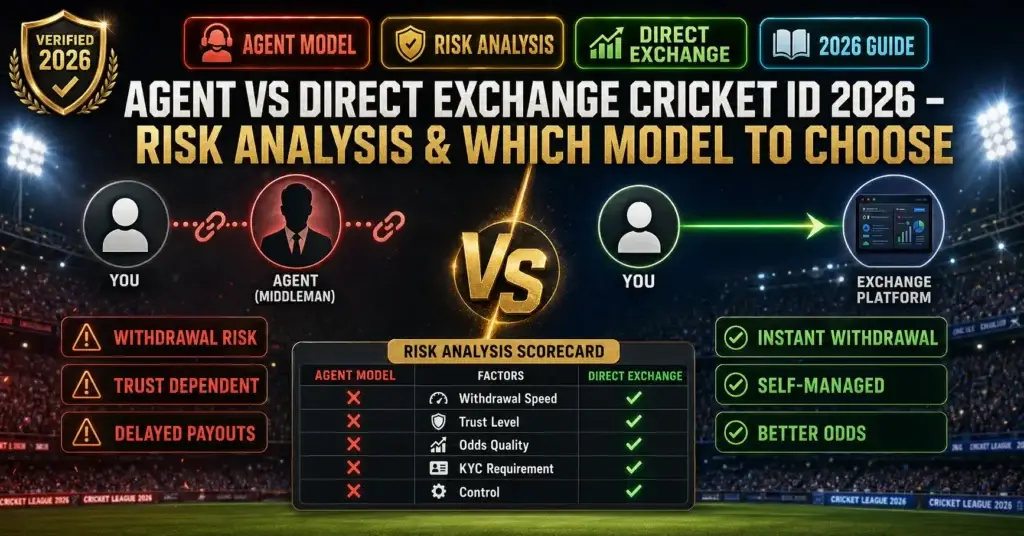
Risk Comparison Table — Agent based vs direct exchange cricket id
| Risk Factor | Agent-Based Cricket ID | Direct Exchange Cricket ID |
| Who controls your balance | The agent | You |
| Withdrawal dependency | Agent must release funds | Self-initiated on platform |
| Agent disappearance risk | ⚠️ HIGH — documented frequently | ❌ Not applicable |
| Platform exit risk | ⚠️ HIGH — agent AND platform can fail | ⚠️ LOW — platform only |
| Enforcement risk | ⚠️ HIGH — agent network can be shut down | 🔄 Medium — offshore platform risk |
| Account recovery if locked | ❌ Depends on agent | ✅ Platform support channel |
| Fraud documentation | WhatsApp messages only | Platform transaction history |
| Deposit transparency | Agent credits manually | Automated, verifiable |
| Identity verification | None — no platform record of you | Direct platform registration |
| Recommended for | ❌ Only with long-verified agent | ✅ All bettor levels |
When Does the Agent Model Have Any Legitimate Use?
It would be intellectually dishonest to suggest the agent-based cricket ID model has zero legitimate use cases in India. It does — under very specific conditions.
The one legitimate use case: A bettor with a personally verified, multi-year relationship with a specific agent, backed by community reputation and direct personal accountability, may operate safely within an agent-based structure.
The operative words are personally verified and multi-year. This means:
- You know the agent personally — not just via WhatsApp
- The agent has a documented track record of prompt withdrawals over multiple IPL seasons
- Other bettors in your direct personal network have used the same agent and verified consistent performance
- Your maximum deposited balance at any time is an amount you could afford to lose entirely without financial damage
This is a narrow use case. It describes perhaps 5–10% of Indian bettors who use agent-based cricket IDs. The remaining 90–95% are trusting strangers on WhatsApp with their money.
For everyone else: The direct exchange cricket ID model is unambiguously safer. The odds quality, feature set, and legal protection of direct platforms like Laser247, TigerExch, and LemonBook are equivalent to or better than agent-based alternatives — with dramatically lower account control risk.
The Master ID System — A Specific Clarification
The term “Master ID” creates confusion because it appears in both legitimate and illegitimate contexts.
Illegitimate context (agent-based model): An agent operates a “Master ID” on an offshore platform and sells sub-accounts beneath it to individual bettors. The agent controls all funds. This is the high-risk structure described throughout this guide.
Legitimate context (LemonBook): LemonBook offers a Master ID system where a single account holder can create and manage multiple sub-accounts — but in this context, the Master ID holder is managing their own accounts or a group they directly control. There is no unknown third-party agent between the user and the platform.
The distinction: in the legitimate LemonBook Master ID model, the platform relationship is direct. In the agent-based model, the platform relationship is indirect through an unverified human intermediary.
How to Verify Whether a Cricket ID is Agent-Based or Direct
Before registering with any cricket betting ID provider, verify its model using these four checks:
Check 1: Does registration go through a person or a platform?
Direct model: you register on a platform website or app directly. Agent model: a person on WhatsApp creates your account.
Check 2: Where does your deposit go?
Direct model: you send money to a verified platform payment gateway or UPI linked to the platform. Agent model: you send money to an individual’s UPI ID (e.g., agentname@okaxis).
Check 3: Who initiates your withdrawal?
Direct model: you initiate withdrawals from within your platform dashboard. Agent model: you request withdrawal from an agent via WhatsApp and wait for them to send it manually.
Check 4: Does the platform show your individual transaction history?
Direct model: your dashboard shows all deposits, withdrawals, bets, and balances independently. Agent model: your balance is whatever the agent tells you it is — no independent platform verification available to you.
If any of checks 2, 3, or 4 describe an agent rather than a platform — you are in an agent-based cricket ID structure.
Platform Recommendation — Direct Model Only
Based on the documented risk profile above, our recommendation is unambiguous: use a verified direct exchange cricket ID platform exclusively.
For Indian bettors in 2026, the top verified direct model platforms are:
Laser247 — Best overall for withdrawal speed, crypto support, and multi-season track record.
TigerExch — Best for odds quality through true back-lay exchange model.
LemonBook — Best for lowest entry point and fastest activation.
Cricbet99 — Best for established community trust and brand recognition.
All four provide direct account control, self-managed withdrawals, and platform-level transaction documentation — eliminating the primary risk vectors of the agent-based model entirely.
Frequently Asked Questions — Agent based vs direct exchange cricket id
Q1: What is an agent-based cricket ID?
An agent-based cricket ID is a sub-account beneath an agent’s master account on a betting platform. Your deposits and withdrawals go through the agent via WhatsApp — not directly to the platform. The agent controls your balance. This model carries significant risk because the agent can disappear, be arrested, or withhold funds with no platform-level recourse available to you.
Q2: What is a direct exchange cricket ID?
A direct exchange cricket ID is an individual account registered directly with the betting platform — no agent intermediary. You deposit and withdraw directly through the platform dashboard. Your balance and transaction history are independently verifiable on the platform. Direct model platforms in the verified Indian market include Laser247, TigerExch, LemonBook, and Cricbet99.
Q3: Why is the agent-based cricket ID model risky?
The agent-based cricket ID model is risky because the agent controls your funds. If the agent disappears, is arrested, or decides to withhold your balance, you have no independent recourse to the platform — the platform does not recognise you as an individual user. Documented agent disappearance cases in India have resulted in total loss of deposited balances for sub-account holders.
Q4: Is Mahadev Book agent-based or direct?
Mahadev Book operated on an agent-based master ID model — one of the largest such networks in India before major enforcement actions in 2023–2024. Sub-account holders under Mahadev Book agents lost deposited balances when agents disappeared following enforcement. This is the most widely documented agent-based cricket ID risk case in Indian cricket betting history.
Q5: What is the difference between a Master ID and a direct cricket ID?
A Master ID in the agent-based model is the top-level account an agent uses to manage multiple sub-accounts beneath them — your funds sit in their master account, not in your own. A direct cricket ID gives you an individual account directly with the platform — your funds are in your account, self-managed. LemonBook also uses “Master ID” terminology for a legitimate multi-account management feature — this is a direct-model feature, not an agent-based one.
Q6: How do I know if my cricket ID is agent-based or direct?
Four checks: (1) Did you register through a person on WhatsApp or directly on a platform? (2) Did you send your deposit to an individual’s UPI ID or to a verified platform gateway? (3) Do you request withdrawal from an agent via WhatsApp or initiate it yourself on a platform dashboard? (4) Can you independently verify your balance and transaction history on a platform — or only through the agent? Agent involvement in checks 2, 3, or 4 indicates an agent-based model.
Q7: Can I recover money lost through an agent-based cricket ID fraud?
Recovery options are limited. A cybercrime complaint at cybercrime.gov.in or on the 1930 helpline can freeze UPI transactions in some cases if reported immediately. However, if the agent has withdrawn the funds and disappeared, recovery is extremely difficult — particularly because the underlying activity exists in a legal grey area. Prevention through using direct model platforms is significantly more reliable than attempted post-fraud recovery.
Q8: Which direct exchange cricket ID platform is safest for Indian bettors?
Laser247 and TigerExch have the strongest multi-season track records among verified direct exchange cricket ID platforms. Laser247 scores highest overall on withdrawal speed, minimum deposit, and payment flexibility. TigerExch scores highest on odds quality through its true peer-to-peer exchange model. Both are direct model platforms with individual account control and no agent intermediary.
Q9: Does the agent-based model offer any advantages over direct exchange?
The agent-based model’s claimed advantages — higher betting limits, personalised service, access to exclusive platforms — have largely been eroded by improvements in direct model platforms. Laser247 and TigerExch both offer higher limits, full market access, and comparable customer service. The only scenario where agent-based retains a legitimate use case is a personally verified, multi-year relationship with a specific agent — which describes a small minority of Indian bettors.
Related reading — recent guides on this site
- Sportsbook vs Exchange for Cricket — The market-model comparison, distinct from the account-model one.
- Cricket ID KYC and Verification — How agent-based and direct accounts differ at verification.