
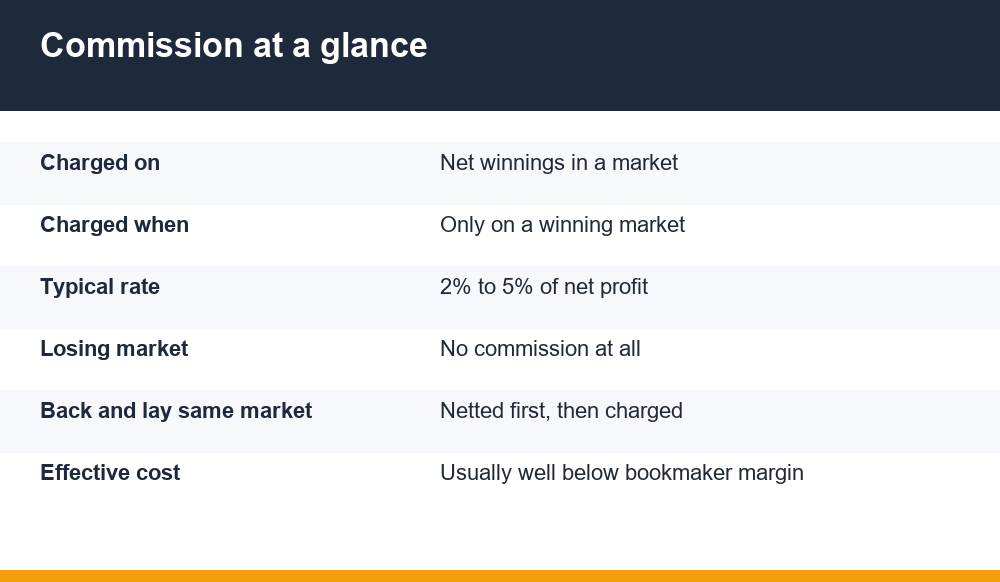
Betting exchange commission is the part of exchange betting that confuses newcomers most, and the confusion usually runs in the wrong direction: people assume it makes exchanges expensive. In practice it makes them considerably cheaper than a traditional bookmaker in most situations, because of where and when it is applied. Commission is charged on net winnings within a market, not on every bet and not on turnover, which means a losing market costs nothing at all. The six worked examples below show the arithmetic in each common situation, including the two cases where an exchange genuinely is the worse option.
Table of Contents
What betting exchange commission actually is
An exchange does not take a position. It matches one customer who wants to back an outcome against another who wants to lay it, and takes a fee from whoever ends up in profit. There is no margin baked into the odds because the odds are set by the two customers, not by the house.
That is the structural difference and it explains everything else. A bookmaker earns by pricing below true odds on every bet, win or lose. An exchange earns a percentage of your profit when you have one, and nothing when you do not.
Per market, not per bet
The crucial detail is the unit of account. Commission is calculated on your net position in a single market, after all bets in that market are settled against each other. Several bets on the same match are netted first; a profit elsewhere does not offset a loss here. Getting this wrong is the source of most miscalculations.
Example one: a simple winning back bet
You back a team at odds of 3.0 with a stake of ₹1,000, and they win. The gross return is ₹3,000, of which ₹1,000 is your own stake back and ₹2,000 is profit.
Commission at 5 per cent applies to the ₹2,000 profit, not to the ₹3,000 return and not to the ₹1,000 stake. That is ₹100, leaving ₹1,900 net profit and ₹2,900 returned to your balance.
The single most common error is applying the rate to the gross return, which would give ₹150 and overstate the cost by half. Commission never touches your stake.
Example two: the losing bet
Same bet, and the team loses. You lose the ₹1,000 stake.
Commission charged: nothing. There is no profit in the market, so there is no fee. This is the asymmetry that makes exchanges cheaper over time, and it is the part newcomers consistently fail to account for when comparing the two models.
Against a bookmaker, the margin was applied the moment you took the price, regardless of the result. On an exchange you pay only when you win, which means the effective cost across a losing run is zero rather than compounding.
Example three: laying, where liability bites
Laying means taking the other side: you accept someone else’s backing stake and pay out if the outcome happens. The arithmetic reverses and the risk profile changes sharply.
Lay a team at 3.0 for ₹1,000 and your liability is ₹2,000, calculated as the stake multiplied by odds minus one. If the team loses, you keep the ₹1,000 and pay commission on it, so at 5 per cent you net ₹950. If the team wins, you pay out ₹2,000.
The figure to watch is liability rather than stake. At odds of 10.0 a ₹1,000 lay carries ₹9,000 of liability, and the commission on the modest win is irrelevant next to the exposure. Laying long shots is where new exchange users most often get hurt, and it has nothing to do with the fee.
Example four: backing and laying the same market
Because positions in one market are netted before commission is applied, taking both sides is cheaper than it first appears.
Suppose you back at 3.0 for ₹1,000, the price shifts, and you lay at 2.5 for ₹1,200 to lock in a position. Whatever happens, your net profit in that market is the same, and commission applies once to that net figure rather than separately to the winning leg.
That is why trading in and out of a market is viable on an exchange and would be impossible against a bookmaker’s margin. The fee is charged on what you actually made across the whole market, not on each transaction along the way.
- Netting happens per market, not per account or per day
- A loss in one market never offsets commission in another
- Settled and unsettled bets in the same market net together at settlement
- Cancelled or unmatched bets are irrelevant to the calculation
Example five: comparing against a bookmaker price
This is the comparison that actually decides where to place a bet, and it needs doing on the net figure rather than the headline.
An exchange offers 3.1 with 5 per cent commission. A bookmaker offers 3.0 with no commission. On a ₹1,000 stake the exchange returns ₹2,100 profit less ₹105 commission, so ₹1,995. The bookmaker returns ₹2,000. The bookmaker is marginally better here, despite the lower headline price.
| Exchange price at 5% commission | Equivalent bookmaker price |
|---|---|
| 2.10 | 2.045 |
| 3.00 | 2.90 |
| 5.00 | 4.80 |
| 11.00 | 10.50 |
The rough rule is to subtract about 5 per cent of the profit portion, which widens in absolute terms as odds lengthen. Exchanges typically still win the comparison, because their prices are set by competing customers rather than by a book with a built-in overround, but it is worth checking rather than assuming.
Example six: the small-margin trade
Here is the case where betting exchange commission genuinely hurts, and it is worth knowing before anyone attempts it.
If you are trading small price movements, taking perhaps 2 per cent on each position, a 5 per cent fee on the profit consumes a sizeable share of a thin margin. Add the spread between available back and lay prices and the strategy can be negative despite a good hit rate.
This is precisely why serious traders care so much about commission rates, while occasional bettors barely notice them. At one or two trades a month the rate is almost irrelevant; at several hundred, it is the difference between a viable approach and a pointless one.
If you are new to taking both sides of a market, our explanation of how backing and laying work together covers the mechanics before the costs become the interesting part.
Why rates differ, and discount schemes
Headline rates generally sit between 2 and 5 per cent, and the differences between platforms are real but smaller than they appear, because the structure around the rate matters as much as the number.
Several exchanges operate discount schemes that reduce the effective rate as cumulative activity grows, and some apply different rates to different sports or to in-play markets. A platform advertising 2 per cent may apply it only to selected markets, with the standard rate elsewhere.
Two things are worth checking on any platform before the rate itself. First, whether commission is charged on net market profit, as described throughout this page, or on some broader definition. Second, whether there are additional charges for high-volume activity, which exist on at least one major exchange and are not part of the advertised commission at all.
For most people placing occasional bets, the rate is the least important variable on the page. Liquidity matters far more: a market with few participants produces worse prices than any commission rate would cost you, and that gap is invisible until you try to get a bet matched at the price you wanted.
What commission does not cover
Three costs sit alongside betting exchange commission and are easy to overlook when comparing platforms, because none of them appears in the advertised rate.
The first is the spread. Every market has a best available back price and a best available lay price, and they are never the same number. Crossing that gap costs you something on entry and again on exit, and on an illiquid market it can exceed anything the commission takes.
The second is unmatched volume. An exchange price is only real if somebody is there to take the other side at that amount. A tempting price with a few hundred rupees available behind it is not the price you will get on a serious stake, and partial matching leaves you with a position you did not intend.
The third is settlement timing. Funds in matched but unsettled positions are unavailable, and on markets that settle slowly this ties up a balance for longer than people expect. None of these is hidden, exactly, but none of them is in the headline either.
Taken together they argue for judging an exchange on the depth of its markets in the sports you actually follow, rather than on the commission rate printed on the homepage. A platform charging 5 per cent in a deep market will usually cost you less in practice than one charging 2 per cent in a thin one.
A closing word on how the fee feels against how it behaves. Paying a visible percentage out of a win is psychologically unpleasant in a way that a bookmaker’s invisible margin is not, which leads people to overestimate what exchanges cost them. The margin at a bookmaker is simply never shown; it was taken when the price was set, including on every bet that lost.
Run a season through both models and the exchange usually comes out ahead for anyone betting with any regularity, despite the fee appearing on every winning slip. The visible cost is smaller than the invisible one. That is counterintuitive enough that it is worth checking against your own records rather than taking anyone’s word for it, including this page’s.
For anyone keeping records, the useful figure to track is commission as a percentage of total stakes rather than of winnings, because that is the number directly comparable with a bookmaker margin. Someone paying five per cent on profits across a season of roughly break-even betting will often find the total lands somewhere near one per cent of turnover, which is a different and far smaller figure than the headline rate implies, and it is the one that belongs in any honest comparison between the two models.
Keep those records from the first month rather than starting when something looks wrong. Reconstructing a season afterwards from an account statement is possible but tedious, and the numbers that matter here only become meaningful across a reasonable sample.
Frequently Asked Questions
Is commission charged on winnings or on turnover?
On net winnings within a single market, never on turnover and never on your stake. If a market produces no profit, no commission is charged at all, which is the main structural advantage over a bookmaker’s margin.
Do I pay commission if I lose?
No. Commission applies only where your net position in that market is a profit. A losing market costs nothing beyond the loss itself, which is why the effective cost of an exchange across a losing run is zero.
How do I compare an exchange price with a bookmaker’s?
Subtract the commission from the profit portion of the exchange return. At 5 per cent, an exchange price of 3.0 is roughly equivalent to a bookmaker’s 2.90. The gap widens in absolute terms as odds lengthen, so the comparison matters more on long shots.
What is liability when laying?
The amount you pay out if the outcome you laid actually happens, calculated as stake multiplied by odds minus one. Laying ₹1,000 at odds of 10.0 carries ₹9,000 of liability, which is the figure to watch rather than the stake.
Is a lower commission rate always better?
Not necessarily. Liquidity usually matters more for ordinary bettors, since a thin market produces worse prices than any rate difference would cost. Rates become decisive only at high trading volumes, where a few percentage points determine whether a thin-margin approach works.