If you have ever placed an exchange bet that just sat there doing nothing, the unmatched bet meaning is the first thing to get straight: it is an offer nobody has accepted yet, not a live bet. Your stake is set aside while the exchange waits for another user to take the opposite side. This explainer walks through matched, unmatched and partially matched states, what happens at the first ball, and the warning signs that a platform is misusing the term.
Table of Contents
Unmatched Bet Meaning on a Cricket Exchange
A betting exchange is not a bookmaker. There is no house taking your bet; the platform simply pairs users who disagree about an outcome and charges commission on winnings. Every bet therefore needs a counterparty — someone willing to accept the exact opposite position at the price you named.
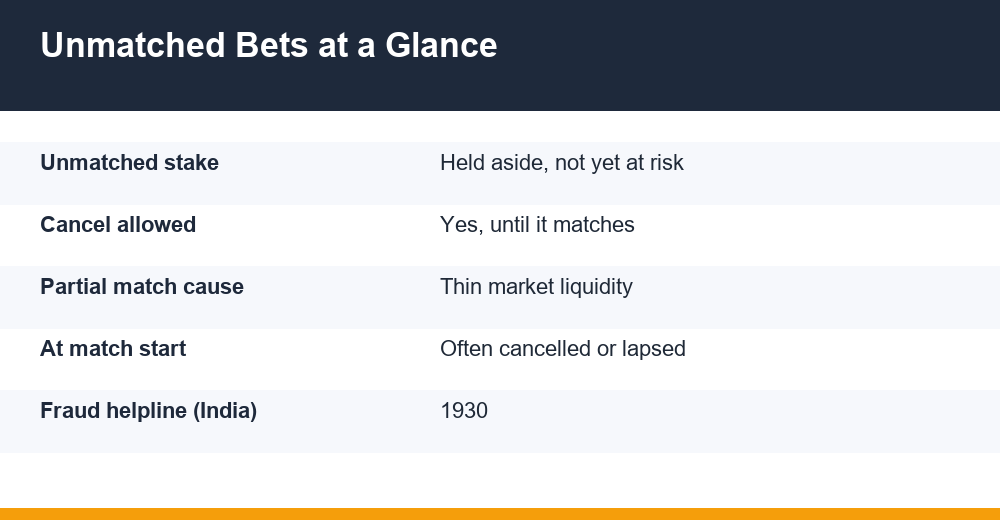
That is the heart of the unmatched bet meaning: you have made an offer at a price, and until another user accepts it, no bet exists. The exchange holds your stake aside, your offer sits in a queue at that price, and nothing is won or lost while it waits. The moment someone takes the other side, the status flips to matched and the bet becomes binding.
This applies to both sides of the order book. Whether you back an outcome to happen or lay it to fail, your request can sit unmatched. How those two sides pair up is covered in detail in our explainer on how back and lay positions work on an exchange; for this article, the key point is that an unmatched entry is a pending offer, not an accepted wager.
- Unmatched = an open offer waiting for a taker
- Your stake is reserved but no risk is live yet
- The bet only becomes real when another user matches it
- You keep control of the offer until that moment
The vocabulary comes straight from financial order books, which is why it feels unfamiliar to anyone used to a traditional bookmaker. With a bookmaker, your bet is accepted or rejected the instant you tap. On an exchange there is a third possibility in between: accepted by the platform as an order, but not yet accepted by any human on the other side.
One more thing worth saying plainly before the mechanics: anything matched on an exchange is a real-money wager on a chance outcome, with commission working against you over time. These products are for adults 18 and over, and no bet state — matched or otherwise — changes that basic risk.
Matched, Unmatched and Partially Matched: The Three States
Exchange interfaces, including the cricket-focused apps popular in India, show every order in one of three states. Misreading them is the single most common support complaint, because a slip full of unmatched entries looks almost identical to a slip full of live bets.
| State | What it means | Is money at risk? | Can you cancel? |
|---|---|---|---|
| Matched | Another user accepted your full stake at your price | Yes — the bet is binding | No, only trade out of it |
| Unmatched | Nobody has accepted any of your offer yet | No — stake is held, not wagered | Yes, at any time |
| Partially matched | Part of the stake was accepted; the rest still waits | Yes, on the matched part only | Yes, the unmatched part |
The practical difference shows up at settlement. A matched bet pays out or loses according to the result. An unmatched offer settles nothing: whether it is cancelled by you or lapses by rule, the held stake simply returns to your balance. That is why the unmatched bet meaning matters more than any other piece of exchange vocabulary — it decides whether the result of the match affects your money at all.
A partially matched bet is both things at once. If you asked for 5,000 at odds of 2.10 and only 2,000 was taken, you hold a live 2,000 bet plus a pending 3,000 offer. The two halves settle independently, which trips up a lot of people when they read their statement afterwards.
Platforms label these states inconsistently. You may see open orders, pending, waiting or simply a greyed-out row instead of the word unmatched, and some apps separate cancelled by the user from voided by the platform. Before you stake anything, find the screen that lists open orders and learn which column on your app tells you whether a stake is live. The figures above are illustrative; what matters is the state, not the amount.
Why Bets Stay Unmatched: Liquidity Breakdown
An offer stays unmatched for one simple reason: at the price you asked, nobody on the other side wants the trade. On an exchange, price and demand do all the work. There are three common versions of this.
- Your price is off-market. If the best available back price is 1.95 and you ask for 2.20, your offer joins the queue and waits for the market to drift your way — which it may never do.
- The market is thin. Small leagues, minor T20 matches and late-night games attract little money, so even a fair price can sit untaken for overs at a time.
- The price moved while you clicked. Cricket odds swing on every boundary and wicket. An offer entered a second too late can miss the money entirely.
The amount of money waiting at each price is called liquidity, and you can usually see it stacked under the odds buttons. Reading those columns correctly tells you in advance whether your stake is likely to match instantly or sit in a queue. We break down how to read that ladder in our piece on interpreting market depth on cricket exchanges.
Queue position matters too. Offers at the same price generally match in the order they arrived, so a large stake placed behind other users’ money can match slowly, in pieces, or not at all. None of this is a malfunction — it is the market telling you what the other side is willing to accept.
Timing within the cricket calendar explains a lot as well. A marquee international or a major franchise fixture draws deep two-way money for days beforehand; a second-tier domestic game may only come alive in the final hour before the toss. If your offer sat untouched all afternoon and then matched in seconds, nothing changed about your order — the number of people in the market did.
Why Was My Exchange Bet Only Partially Matched?
A partial match happens when the money available at your chosen price is smaller than your stake. The exchange fills what it can immediately and leaves the remainder as an open offer. If 2,000 is on offer at your odds and you request 5,000, you get matched for 2,000 and the other 3,000 waits.
Thin liquidity is the usual culprit. Big international fixtures carry deep markets where five-figure stakes vanish instantly; a low-profile domestic match might have only a few thousand waiting at the front price. The same stake that matches in full on one game splits on another.
Fast-moving prices cause partial fills too. During a live over, the money at a price can be consumed by other users in the moment between you seeing it and your order arriving. You catch the tail end of the queue, match a slice, and the rest misses.
- Check the visible money at your price before staking large amounts
- Split big stakes into smaller orders if the market is shallow
- Remember the matched slice is live even if the rest never fills
- Review the unmatched remainder — cancel it or let it wait, deliberately
The remainder behaves like any fresh unmatched offer: it can match later at your price, be cancelled by you, or lapse under the platform’s match-start rules. What it cannot do is quietly change your matched portion — that part is locked at the odds you received.
Reading a partially matched entry on your statement
Statements usually list the matched portion as a settled or live bet with its own stake and odds, while the pending remainder appears separately, or disappears once it is cancelled. If the totals look wrong, add the two halves together before assuming an error. Knowing the unmatched bet meaning makes this reconciliation quick: only the filled slice can ever affect your balance.
What Happens to an Unmatched Bet When the Match Starts?
The first ball is the moment exchange platforms clean up their order books, and the handling of pending offers at that point varies by operator. The most common default is that unmatched offers are cancelled or lapse when the market turns in-play, with the held stake returned to your balance. Pre-match prices rarely make sense once play begins, so wiping stale offers protects users from being matched at absurd odds.
Some exchanges offer a keep option: you tick a box asking for your unmatched offer to carry over into the in-play market at the same price. If you never chose it, assume your pending offers die at the start. Either way, nothing about the transition can lose you money on the unmatched portion — the stake was never wagered.
In-play markets also pause constantly. At a wicket, a run-out referral or an innings break, the platform freezes all betting for a short window, and on many exchanges unmatched offers are cleared at these moments too. If your pending bet vanished mid-match, a suspension is the likely reason — our explainer on why cricket markets get suspended covers those pauses in full.
Many exchanges also apply a short delay to in-play orders, holding them a second or two before they reach the book. That is why an in-play offer can show as unmatched for a beat, then either fill or vanish as the price moves on.
Because behaviour genuinely differs between platforms, the honest answer is: read the market rules on the site you use, before the toss. A legitimate exchange states its in-play transition policy in writing. A platform that cannot tell you what happens to pending offers at match start is telling you something else entirely.
Can You Cancel an Unmatched Bet?
Yes. On any genuine exchange, an unmatched offer can be cancelled at any time before it matches, and cancellation is free. Open your bet slip or open-orders screen, find the entry marked unmatched, and remove it. The reserved stake returns to your available balance immediately.
The only race you can lose is against the matching engine. If another user accepts your offer in the seconds before your cancellation lands, the bet is matched and binding — there is no undo on a matched bet. On partially matched orders, you can cancel only the unmatched remainder; the filled slice stays live. On some in-play markets a short bet delay exists, and a cancellation during that window stops the order before it can match.
Platforms also cancel pending offers themselves, without any wrongdoing. Market suspension, the switch to in-play, a market closing early and an order book being cleared on settlement are all routine reasons. These show up as cancelled or voided rather than lost, and the held stake comes back. If a cancellation is ever shown without the stake returning, that is a balance question for support, not a feature of exchange mechanics.
Does an unmatched bet lose money?
No — and this is where the unmatched bet meaning protects you. An unmatched offer has no counterparty, so there is nothing to win or lose from the match result. Whether you cancel it, it lapses at the start of play, or the market closes with it untaken, the full held stake comes back.
What an unmatched offer does cost you is opportunity and access. The reserved stake cannot be used elsewhere while the offer sits open, and a pending offer cannot be cashed out, because there is no live position to trade against. If actual money has gone missing against an entry a platform calls unmatched, that is not how exchanges work — treat it as a dispute, not a rule.
What Happens to Unmatched Bets If a Match Is Abandoned?
Rain, bad light and unsafe pitches end plenty of cricket fixtures early, and the washout treatment differs for the two bet states. Unmatched offers are the simple half: when a market is abandoned and closed, pending offers are cancelled and the held stakes return in full. There was never a live bet, so there is nothing to settle.
Matched bets are governed by each platform’s market rules, and these genuinely vary. Common patterns across operators include voiding match-odds bets and refunding stakes when no result is possible, minimum-overs thresholds before certain markets stand, and time windows — for example, voiding bets if an abandoned match is not resumed within a stated period. None of these numbers is universal; the rules page of the specific market is the only authority.
- Unmatched offers: cancelled, stake returned in full
- Matched bets, no result: typically voided and refunded under the market’s rules
- Reduced-overs finishes: settlement often depends on stated overs thresholds
- Always screenshot your open bets before a weather delay
A venue change or a fixture moved to another date works similarly: some markets stand, some are voided, and the commission you pay applies only to net winnings on matched bets that actually settle.
A refund of a voided matched bet is a stake returned, not a win. And a platform that delays or refuses refunds after a washout, or reclassifies matched bets as unmatched after the abandonment, is behaving in a way no published exchange rulebook supports — which brings us to the warning signs.
Red Flags Around Unmatched Bets on Shady Apps
The unmatched bet meaning is precise, which makes it a useful test of any platform. Unofficial cricket ID apps and private exchange clones sometimes borrow exchange vocabulary without running a real order book, and the word unmatched becomes a place to hide money. Judge for yourself, but these patterns deserve suspicion:
- Winning bets retroactively relabelled unmatched or void after the result is known
- Unmatched stakes that do not return to your balance when cancelled
- No visible liquidity or market depth, yet bets still match instantly
- No written market rules covering match start, suspensions or abandonment
- Deposits via personal UPI handles instead of a company account
- Withdrawals that stall indefinitely while an agent asks for more deposits
A genuine exchange cannot lose your money in the unmatched state, because that money was never in play. Any platform where it does is not operating an exchange, whatever its interface looks like. Keep records: screenshots of open orders, transaction IDs and chat logs are what turn a complaint into an actionable report.
The quickest sanity check costs nothing. Place the smallest allowed offer well away from the market price, watch it sit as unmatched, then cancel it and confirm the stake lands back in your balance within seconds. An app that cannot pass that test is not keeping an order book, and nothing else about it is worth your time.
If money has been taken from you through such an app, act quickly. In India, call the cyber fraud helpline 1930 and file a complaint at the National Cyber Crime Reporting Portal; fast reporting improves the chance of payments being frozen. And if betting itself has stopped feeling like a choice, free and confidential support exists — Tele-MANAS at 14416 is a 24×7 mental health helpline available across India. Every matched stake rides on chance, with commission working against you, so treat these mechanics as protection, never a system.
Frequently Asked Questions
What happens to an unmatched bet when the match starts?
On most exchanges, unmatched offers are cancelled or lapse when the market turns in-play, and the held stake returns to your balance. Some platforms offer a keep option that carries the offer into the live market at the same price. The exact behaviour varies by operator, so check the market rules on your platform before the first ball.
Why was my exchange bet only partially matched?
Because the money available at your chosen price was smaller than your stake. The exchange matched what it could and left the remainder as an open offer. This is common in thin markets, such as minor matches, and during fast live price swings. The matched slice is live; the rest waits, and you can cancel it whenever you like.
Can I cancel an unmatched bet?
Yes, at any time before it matches, with no fee. Open your bet slip or open-orders screen and remove the unmatched entry; the reserved stake returns to your balance immediately. If another user accepts your offer before the cancellation lands, the bet becomes matched and binding. On partially matched orders, only the unmatched remainder can be cancelled.
What happens to unmatched bets if a match is abandoned?
They are cancelled when the market closes, and held stakes return in full, since no live bet ever existed. Matched bets follow the platform’s market rules instead: many operators void and refund them when no result is possible, sometimes subject to minimum-overs or resumption-time conditions. The specific market’s written rules are the only reliable authority.