Session betting in cricket is the market quoted most heavily on exchange-style apps aimed at Indian viewers, yet the words that surround it — fancy, yes, no, line, rate, khai, lagai — are almost never explained in plain language. This page decodes that terminology strictly as information for adults 18+. Nothing here is a tip or a system: every session market is a chance outcome carrying a built-in operator margin, and real money is at risk whenever it is staked.
Table of Contents
What a Session Means on a Cricket Market
In the sport itself, a session is a scheduled block of play. A day of Test cricket is divided into three of them: the morning session from the start of play to lunch, the afternoon session from lunch to tea, and the evening session from tea to stumps. Scorers and commentators have totalled runs and wickets session by session for well over a century, which is why the word travelled so easily onto betting screens.
On exchange-style apps, though, the word is used far more loosely. A “session” there means any fixed stretch of an innings that the operator chooses to quote — not only the lunch-and-tea blocks of a Test. The first six overs of a T20, the first ten overs of an ODI innings, or a team’s score at a set over mark can all be labelled sessions.
The core idea never changes on the market side: it asks how many runs will be scored inside a defined block, and a position is taken against a posted number. Typical labels include the following, all illustrative, since every platform words its screens differently:
- “1st innings 10 over runs” — total runs after ten overs of the first innings
- “Session runs” in a Test — runs scored between two scheduled intervals
- “6 over runs IND” — a team’s powerplay total in a T20
- “Fall of 1st wicket” — quoted beside session lines, though it is a different fancy market
Because the block is short and self-contained, these markets settle quickly, often inside the hour. That speed is exactly what makes them absorbing on screen and costly in practice: fast settlement invites fast re-staking, and each new stake is a fresh chance outcome rather than a continuation of the last one.
How Session Betting in Cricket Actually Works
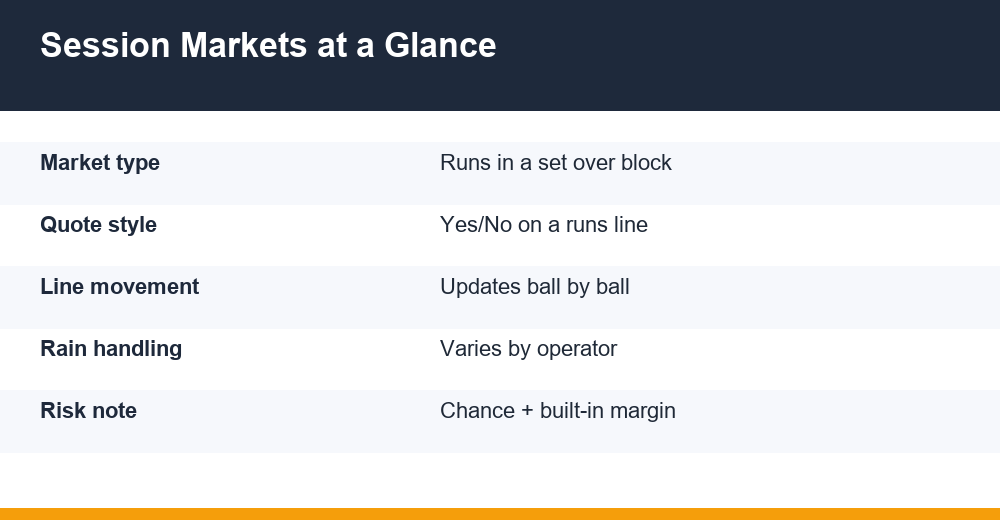
At its core the market behaves like an over/under. The platform posts a runs line — say 62 for the first ten overs — and a user takes the view that the actual total will finish above or below it. Finish above and the “yes” side is paid; finish below and the “no” side is paid. The match result is irrelevant.
The line is live. Every ball changes it: a boundary nudges the number upward, a maiden over drags it down, and a wicket usually pulls it down sharply because new batters tend to score slower. Watching a session line move is essentially watching the operator reprice its own expectation in real time, several times an over.
The two-sided structure mirrors the exchange logic set out in our breakdown of back and lay betting: one side of the market always holds the opposite view to the other. On fancy screens the trade words lagai (backing a quoted line) and khai (taking the other side of it) carry the same meaning.
What the screen rarely spells out is the margin. The gap between the “no” figure and the “yes” figure — or between the payout rates attached to each side — is the operator’s edge. Both sides are priced so the platform profits across thousands of positions whatever individual matches do. The result of any single block is chance; the margin is permanent. This material is for adults 18+ only.
Each session market also carries its own minimum and maximum stake, set per market rather than per match, and those limits can be cut mid-innings as the block shortens.
Yes, No and the Numbers Beside the Line
What yes and no mean in fancy quoting
On a fancy screen, yes means the quoted figure is expected to be reached or passed — more runs than the line, a wicket falling before a stated score, an event happening. No means it is expected not to happen, or the total to stay under. The two words simply replace the over/under labels used on international sportsbooks; the mechanics are identical.
Reading the paired numbers
Display conventions vary by platform, but two patterns dominate. Many screens show a pair such as 44/46: the lower figure is the line attached to “no” and the higher figure the line attached to “yes”, with the two-run gap acting as the operator’s margin. Others add rate figures such as 100/95, showing how much each side pays per 100 units staked.
How a position actually resolves
A session position is locked at the line and rate showing when it is accepted, not the line showing at the end of the block. If the quote was 44/46 and a “yes” position was taken at 46, the block has to finish on 47 or more for that side to be paid, however far the line drifts afterwards. This is why two users on the same market can hold completely different lines at the same moment.
| Term | Where you see it | What it means |
|---|---|---|
| Session | Market title | A fixed block of overs or play being quoted |
| Fancy | Market category | Umbrella name for in-play side markets |
| Yes | Right-hand option | Position that the line will be reached or passed |
| No | Left-hand option | Position that the total stays under the line |
| Line | Centre of the quote | The runs or score figure the market pivots on |
| Rate | Beside the line | Payout per 100 units staked on that side |
| Lagai | Exchange slang | Backing a quoted outcome |
| Khai | Exchange slang | Taking the opposite side of a quote |
If colour-trading apps appear to use a similar two-button layout, that resemblance is not accidental — the comparison is unpacked in colour prediction vs fancy bets. A binary choice feels easier to judge than it is, because the pricing behind both buttons already accounts for the expected outcome and adds the house margin on top.
How a Session Runs Line Is Set and Why It Moves
Session lines come from trading teams and pricing models, not from guesswork. Before a block starts, the opening line reflects an expected total built from measurable inputs: the current run rate, which batters are at the crease, which bowlers are likely to bowl the overs, how the pitch has behaved so far, ground dimensions and historical scoring at the venue.
Once play begins, the model reprices continuously. The main movers are:
- A boundary or a big over — the line climbs as the projected total rises
- A wicket — the line usually drops, since an incoming batter takes time to score
- A bowling change — spin, or a death-overs specialist, shifts expected scoring
- Weather and light — any threat of interruption changes how the block is priced
- Heavy one-sided staking — operators move lines to balance their own exposure
Suspension is part of the mechanism and worth understanding. Fancy markets are typically frozen for a few seconds around every delivery, so the line cannot be taken after the ball has been bowled but before the screen catches up. Quotes also stay suspended through reviews, injury breaks and drinks, and reopen at a repriced number.
That matters because of a claim circulated constantly on social media: that the line “lags” the live feed and that a fast enough finger can take advantage of a stale quote. The suspension windows exist precisely to close that gap, and platforms routinely limit or close accounts whose activity looks like it is tracking a delayed stream. Anyone selling access to such a gap is selling the claim itself, not an outcome.
Session Bet vs Fancy Bet: The Real Difference
The two words are used interchangeably, and that causes most of the confusion. Fancy is the umbrella category: every in-play side market quoted outside the main match-odds screen. A session market is one member of that family — in practice, session betting in cricket is the most heavily quoted fancy market by volume, but far from the only one.
Other fancy markets commonly sitting beside session lines include:
- Player runs — an individual batter’s total, quoted yes/no against a line
- Fall of wicket — the team score at which the next wicket falls
- Total fours or sixes — boundary counts for an innings or a block
- Next-over runs — a single over quoted as its own micro-market
- Partnership runs — the current pair’s combined total
So the accurate formulation is that every session bet is a fancy bet, while most fancy bets are not session bets. The distinction matters at settlement, because operators often publish different void and stoppage conditions for team-block markets than for player markets. A batter retiring hurt, for instance, triggers rules that have no equivalent on a session line.
Conditions are written per market, not per app, so the rules attached to a ten-over session line may differ from those on a player-runs line quoted beside it. Reading the specific conditions before staking is the single most protective habit available.
Over Blocks by Format: A Breakdown
The blocks an operator quotes depend on the format, because each format has different natural pauses. The table below shows typical patterns — illustrative only, since exact offerings differ from platform to platform and match to match.
| Format | Typical blocks quoted | What to know |
|---|---|---|
| Test | Morning, afternoon and evening session runs; score at lunch; day total | Blocks follow the scheduled intervals, so they are long and lines move slowly |
| ODI | 1–10, 1–25 and 1–35 over runs; 50-over innings total | Ten-over blocks dominate; a new line opens at each quoted mark |
| T20 | 1–6 (powerplay), 1–10, 1–15 over runs; 20-over total | Shortest blocks and fastest movement; markets suspend very frequently |
Notice the pattern: the shorter the format, the shorter the quoted block and the faster the screen refreshes. T20 has no scheduled intervals at all, so anything labelled a “session” there is really an over block invented for the market. Test cricket sits at the other extreme, where quoted sessions match genuine scheduled periods of play.
Format also controls how many markets run at once. A televised T20 can carry dozens of simultaneous fancy quotes, while a quiet passage of a Test may carry only a handful. How that depth varies, and why a thin market behaves differently from a deep one, is covered in cricket market depth by format.
Thin quoting has one visible consequence: when few positions are being taken on a block, the distance between the yes and no figures tends to widen, which means a larger built-in margin on an otherwise identical screen.
Rain, Stoppages and Settlement: What to Know
There is no single universal rule for rain. Settlement is governed by each operator’s published market conditions, and those differ from app to app. That said, two principles appear across most rulebooks.
- If the quoted block was completed before play stopped, the market settles on the runs actually recorded, exactly as if the weather had never arrived.
- If the block was cut short and never resumed, the market is commonly voided: the position is treated as though it never happened and stakes are returned.
Between those clean cases sits a grey zone. Some conditions settle an interrupted market on the statistics recorded at the moment play stopped, provided sufficient play has occurred — and the threshold for “sufficient” is often left undefined. Rain-revised targets under the DLS method add another layer: runs already scored do not change, but blocks quoted for overs that no longer exist are typically voided.
Where a platform publishes detailed written conditions, outcomes are at least predictable and checkable afterwards. Where the wording is vague or absent, rain is where disputes concentrate: users report markets voided selectively, “sufficient play” interpreted after the result was known, and credited winnings reversed as a “settlement error”.
The practical point is narrow and testable: find the stated rain rule for that specific market before staking, and treat its absence as an answer in itself. On apps reached through an agent-run ID there is rarely a complaint process a user can realistically reach, so a washed-out block can simply become a frozen balance.
Red Flags Checklist Before Trusting Any Session Screen
None of the following proves that a particular platform is dishonest — readers should judge each case themselves — but these patterns recur constantly in complaints about fancy and session markets:
- Lines that suspend the moment they move in a user’s favour, yet stay open when they move against
- Winning fancy positions reversed after settlement, citing an unexplained “rate mistake”
- Withdrawals that clear instantly for small amounts but stall indefinitely after a winning block
- Deposits routed through an agent’s personal UPI handle or WhatsApp number instead of the platform
- No written settlement conditions anywhere on the site, especially for rain and stoppages
- Pressure to “recover” a lost block immediately on the next quoted line
Two realities sit underneath that list. The money often moves through channels with no recourse: once a deposit reaches an individual’s personal account, no card reversal or complaint desk retrieves it. And the market itself is engineered chance — the margin between yes and no secures the operator’s take, so no run of results changes the long-run arithmetic.
If you believe you have been defrauded through a betting app or a payment agent in India, you can report it on the national cybercrime portal at cybercrime.gov.in or call the financial fraud helpline 1930. Speed matters, because recent transactions are easier to trace than old ones.
And if session betting in cricket has stopped feeling like entertainment and started feeling compulsive, free and confidential help exists. In India, the government’s Tele-MANAS mental health line runs 24×7 on 14416. Readers elsewhere can use the round-the-clock helpline and live chat listed on GamCare’s online support services. Reaching out early is a practical step, not an admission of failure.
Frequently Asked Questions
What is a session in cricket betting?
A session is a defined block of play — the morning, afternoon or evening period of a Test day, or any fixed stretch of overs on most apps. Session betting in cricket means staking on the total runs scored inside that block against a posted line, rather than on the match result, with settlement based on the recorded score.
What do yes and no mean in fancy betting?
Yes means the session total is expected to finish above the quoted runs line; no means it is expected to stay below. The platform prices both sides around its own expected total and keeps the gap between them as margin, so neither button is a value pick. Both are chance positions staked with real money.
How are session bets settled if rain stops play?
There is no universal rule. Most platforms settle on the recorded runs if the block finished before the stoppage, and void the market if the block was cut short and never resumed. The grey zone is a partially played block, where vague wording about “sufficient play” causes most disputes, so read the market conditions first.
What do the numbers next to a fancy line mean?
Conventions vary by platform. Many screens show a pair such as 44/46: the lower figure is the line for a no position and the higher one for yes, with the gap serving as the operator’s margin. Some apps add rate figures like 100/95, showing the payout per 100 units staked on each side.