Withdrawing money is the moment a colour-prediction app either pays out or reveals the conditions buried in its terms. This explainer looks at how cash-outs on apps like BDG Game usually work, why they stall, and eight things worth checking before any money goes in. It is information only: real money is at risk, results come down to chance with a built-in house edge, and these apps are strictly for adults aged 18 and over.
Table of Contents
How Cash-Outs Typically Work
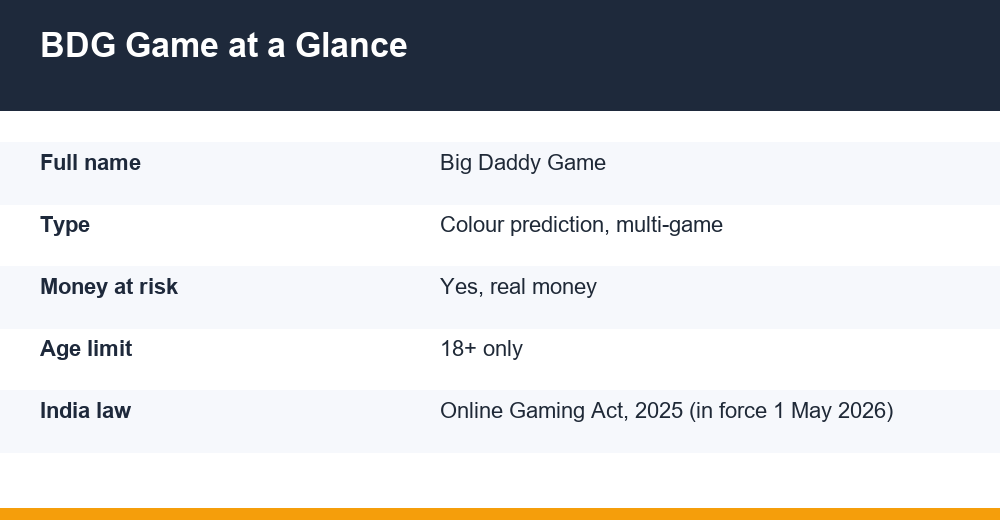
Colour-prediction apps run on an in-app wallet. Big Daddy Game, as the app is often called, offers fast colour rounds alongside other games, and all money moves through that wallet. Across this category of app, the usual sequence looks like this:
- A deposit by UPI or bank transfer is credited to the wallet.
- Bets are placed, and any winnings are added to the balance.
- The player links a bank account or UPI ID for payouts and submits KYC details if asked.
- A withdrawal request is raised, subject to minimums and turnover rules.
- The request is reviewed, then paid, held or rejected.
A payout can be slowed at any one of these steps. The wallet balance on your screen is just a number on the operator’s server, not money in your bank. Limits such as minimum withdrawal and daily caps are set by the operator and can change without notice; figures quoted in Telegram groups are unverified unless the current terms say the same.
India’s Legal Position After the 2025 Act
Parliament passed the Promotion and Regulation of Online Gaming Act, 2025 in August 2025, and it received Presidential assent on 22 August 2025. The Act sorts online games into e-sports, online social games and online money games. It promotes the first two and prohibits the third.
According to the official text on the government’s India Code portal, it is prohibited to offer, aid or facilitate online money games, or to advertise or promote them, and banks and payment systems are barred from processing transactions for them. On 22 April 2026 the central government notified a commencement date for the Act together with the Promotion and Regulation of Online Gaming Rules, 2026, and both came into force on 1 May 2026. This article is not legal advice.
In practice, payments can end up going through intermediaries, personal accounts or payee details that keep changing, which leaves you with little formal recourse if a cash-out goes wrong.
Eight Checks Before You Deposit
If you are still considering it despite the legal position, these checks exist to protect you. None of them makes the games winnable; each targets a common reason a payout ends up delayed or disputed.
- Withdrawal terms in writing. Find the minimum withdrawal, daily limits, processing time and any fees inside the app. If none are published, assume they can change at will.
- Turnover conditions. Many apps require deposits or bonus credit to be bet a set number of times before you can cash out. Accepting a bonus can also lock up your own deposit.
- Name match. The name on the payout account usually has to match the KYC name. Using a relative’s account is a common reason for rejection.
- What KYC asks for. Be very careful about uploading Aadhaar or PAN images to an operator with no verifiable registered company, address or grievance officer.
- Who receives your money. Check the payee name on the UPI screen. If it is an individual, or changes with every deposit, you have no clear party to complain to.
- Support before payment. Ask a specific withdrawal question before you deposit. Evasive answers now will not improve later.
- Banking exposure. Accounts caught in a fraud-investigation chain are sometimes frozen, which puts your own bank account at risk.
- Your loss limit. Decide on an amount you could lose completely without it affecting rent, fees or family expenses.
Why Withdrawals Get Stuck
The status usually reads “processing” or “under review” and stays that way. These are the reasons most often given:
- Turnover not met: the wallet shows money, but the required betting volume has not been reached.
- Name mismatch or KYC problems: blurred documents, mismatched dates of birth or a payout account in another name.
- Multiple-account flags: several accounts on one device, network or payment method.
- Bonus rule breaches: the operator decides play broke its promotion terms and voids winnings.
We have looked in more detail at what actually happens when players try to cash out from colour-prediction apps, and the same theme keeps coming up: the rules that decide whether you get paid are often found only after a request fails.
If a payout is held, ask support in writing for the exact rule that applies, and keep screenshots of your balance, transaction IDs and chat history. Never deposit more money to “fix” a stuck withdrawal.
Turnover and the Real Cost of Fast Rounds
A turnover requirement means you must bet a certain total before your balance can be withdrawn. Every bet carries the operator’s built-in margin, so meeting turnover has an expected cost before you cash out a single rupee.
The table below is an illustrative example only. It assumes a ₹1,000 deposit and a hypothetical 5% house edge, which is not a verified figure for any particular app:
| Turnover multiple | Total you must bet | Expected loss at 5% edge |
|---|---|---|
| 1x | ₹1,000 | ₹50 |
| 3x | ₹3,000 | ₹150 |
| 5x | ₹5,000 | ₹250 |
| 10x | ₹10,000 | ₹500 |
Any single session will vary, but over enough rounds the margin wins out. That is what negative expected value means: on average, each bet returns less than it costs.
Speed makes this worse. Our breakdown of how 30-second rounds stack up turnover and cost shows how fast a modest deposit can be cycled through dozens of bets. No pattern, trend chart or prediction service removes the house edge.
Red Flags and Where to Get Help
There is no published evidence that this platform is a scam, and this article does not claim it is one. Still, several warning signs apply to any real-money app:
- A “release fee” or “tax” demanded before a withdrawal can be processed.
- Agents asking for your OTP, UPI PIN or screen-sharing access.
- Pressure to deposit more to “activate” or “upgrade” your withdrawal.
- Support that only answers on personal messaging accounts.
Information pages such as the one for bdg game describe the app and its features, but an information site is not the operator’s binding terms and cannot guarantee a payout.
If you have lost money to fraud or been asked for fees to release funds, call the national cyber-fraud helpline 1930 as soon as you can, or file a complaint on the National Cyber Crime Reporting Portal (cybercrime.gov.in). Quick reporting improves the chance of funds being frozen.
If gaming is affecting your sleep, money, studies or relationships, the government’s Tele-MANAS service offers free, confidential mental-health support around the clock in several languages on 14416 or 1-800-891-4416.
The Bottom Line for Indian Players
Getting paid depends on KYC, name matching, turnover rules and payment channels, and the operator controls every one of them. With the 2025 Act’s ban on online money games in force since 1 May 2026, the safest check of all is not depositing. If you choose to anyway, use the eight checks above and never send extra money to unlock funds. Play is for adults aged 18 and over only. Nothing here is legal or financial advice.
Frequently Asked Questions
How long do withdrawals on these apps usually take?
Processing times are set by the operator and can change at any time. Colour-prediction apps often advertise quick payouts, but KYC reviews, turnover checks and payment-channel problems can stretch this to days. Treat any promised timeline as unenforceable.
Are colour-prediction apps legal to play in India?
The Promotion and Regulation of Online Gaming Act, 2025, in force since 1 May 2026, prohibits offering, facilitating, advertising and promoting online money games, and bars banks and payment systems from processing them. Real-money colour-prediction apps fall within that category. This is not legal advice.
What should I do if I am asked to pay a fee to release my winnings?
Do not pay. A demand for a release fee, tax or deposit to unlock a withdrawal is a classic fraud warning sign. Stop transacting, save all evidence, call the cyber-fraud helpline 1930 promptly and file a complaint at cybercrime.gov.in.