
Colour prediction VIP levels are the tier ladders these apps display beside your profile, promising bigger limits and better cashback as you climb from VIP 0 towards VIP 10. Almost everything written about them is promotional copy selling the perks, so this breakdown looks at the other side: how the ladders are computed, what each tier genuinely changes, and why the design exists at all. It is written for adults 18 and over who want the mechanics before any real money is involved.
Table of Contents
What VIP Levels in Colour Prediction Apps Actually Are
Open almost any colour or number prediction app and you will find a badge on the profile screen: VIP 0, VIP 1, VIP 2 and upward, often running to VIP 10 or beyond. Each level carries a progress bar, a list of perks, and sometimes a one-time upgrade reward. The presentation borrows directly from mobile game battle passes and airline frequent-flyer tiers, and that resemblance is not accidental.
At its core, a VIP ladder is a loyalty programme bolted onto a wagering product. The app tracks how much money you load or stake, converts that into tier credit, and unlocks cosmetic and financial perks at fixed thresholds. The structure looks much the same whichever app brands it, because a large share of these platforms run on a small number of white-label software kits.
Two things are worth fixing in mind before going further. First, the ladder measures spending, not skill: nothing you do inside a round moves your tier except the size of your stakes and deposits. Second, the perks live entirely inside the platform’s own wallet, so their real value depends on whether a withdrawal ever completes – a separate question covered in our look at what actually happens when you try to withdraw.
- The badge reflects money flow, not ability or luck
- Thresholds and perks are set by the operator and can be changed without notice
- Most apps show near-identical ladders because they share the same software kits
- Every perk is denominated in platform credit until a withdrawal actually lands in your bank
How Colour Prediction VIP Levels Are Computed
No prominent prediction app publishes a precise tier formula, and the requirements are usually visible only inside the app, if at all. What follows is the typical structure these products share, so treat every number below as illustrative rather than as a figure quoted from any specific platform.
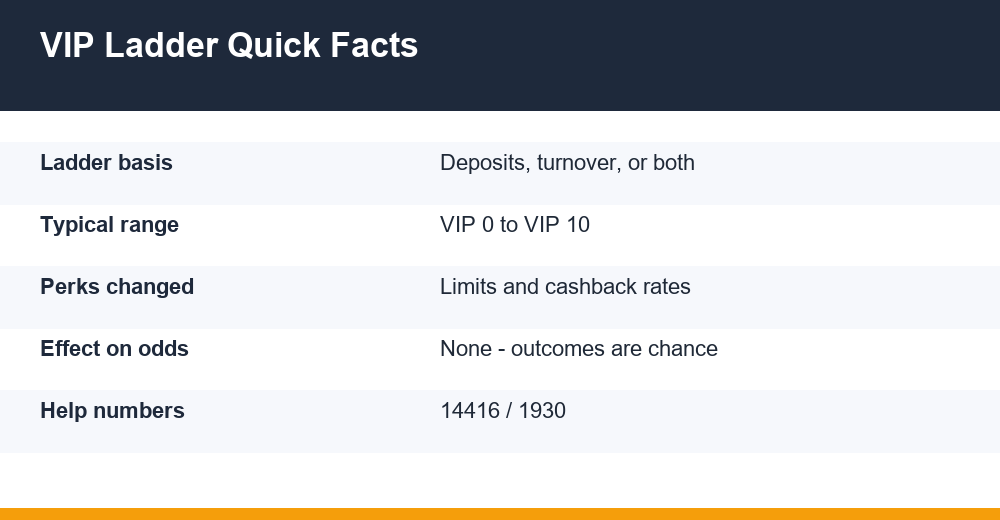
Most ladders use one of three counting methods. The first is cumulative deposits: every rupee loaded into the wallet adds to a lifetime total, and tiers unlock at fixed deposit milestones. The second is turnover, sometimes called wagering volume: every stake counts, including stakes placed with money won earlier. The third, and the most common, is a hybrid that requires both a deposit threshold and a turnover threshold before a level unlocks.
The hybrid design matters. A deposit-only ladder could be climbed by loading money and withdrawing it untouched. A turnover requirement closes that door, because the money has to pass through real rounds – each one carrying the house margin – before it counts. The ladder is therefore computed on precisely the behaviour that earns the operator its money.
| Tier (illustrative) | Cumulative deposit | Turnover required | Typical headline perk |
|---|---|---|---|
| VIP 0 | None | None | Base account |
| VIP 1 | Rs 1,000 | Rs 5,000 staked | Small one-time credit |
| VIP 3 | Rs 30,000 | Rs 1,50,000 staked | Higher daily withdrawal cap |
| VIP 5 | Rs 3,00,000 | Rs 15,00,000 staked | Cashback, faster review queue |
| VIP 8+ | Rs 30,00,000+ | Multiples of deposits | Personal manager, event invites |
Notice the shape of that table. The steps are spaced geometrically, each roughly ten times the one before, so early tiers feel easy and build momentum while the upper tiers quietly demand sums almost nobody would consider spending on day one. The badge sitting next to a VIP 8 account is not a reward for loyalty so much as a record of scale.
Moving up a tier in a colour prediction game
In practice there are only two levers: put in more money, or cycle the money already in the wallet through more rounds. Some apps add a third counter – consecutive daily logins or completed check-ins – but it typically unlocks a token bonus rather than a level. There is no verification step, no performance test and no appeal; the counter simply increments.
Many apps also apply tier decay, quietly dropping a level after a stretch of inactivity, or recalculating tiers monthly rather than on a lifetime basis. That turns a ladder into a treadmill: holding a level requires continuing to stake, which is the real function of the mechanic.
Deposits or total bets – which one counts?
When people ask whether levels track deposits or total bets, the honest answer is usually both, and the app rarely discloses the split. If your tier climbs while you recycle the same balance through many rounds, turnover is driving it. If it only moves when fresh money arrives, deposits are the gate. Either way, the counter moves only when value flows toward the platform.
What Each Tier Genuinely Changes – and What It Does Not
Strip away the gold badges and the benefits of a higher tier fall into three buckets: limits, rebates and service. Everything else – exclusive emojis, profile frames, anniversary gifts – is decoration.
Limits are the most tangible change. Higher tiers usually advertise larger single-round stake caps and higher daily or per-transaction withdrawal ceilings. Larger stake caps are a double-edged benefit: the same badge that lets you move more money per round also lets you lose more per round.
Do higher tiers really raise withdrawal limits?
On paper, often yes. The caveat is that a limit describes the maximum an operator says it might process, not a commitment that it will. Users at every tier report the same friction: pending reviews, turnover conditions attached to bonus credit, and fresh requirements appearing at the worst moment, a pattern traced in our piece on the withdrawal fee demand and how it unfolds. A ceiling is only as meaningful as the payout history behind it.
Rebates are the second bucket: cashback on losses, a slightly higher referral rate, periodic tier bonuses. These are typically fractions of a percent of turnover. A 0.3 percent rebate sounds generous until you set it beside a house margin several times larger. The rebate returns a sliver of money the design already expects you to lose, and it usually arrives as bonus credit carrying its own wagering conditions.
- Limits: higher stake caps and withdrawal ceilings on paper, the same approval process in practice
- Rebates: small percentage cashback and tier bonuses, commonly paid as restricted credit
- Service: priority support or a personal manager whose role is retention, not advocacy
- Cosmetics: badges, frames and gifts with no cash value whatsoever
The service bucket deserves a hard look. A personal manager at high tiers is framed as a privilege, but the role exists to keep an account active. Accounts described by fraud researchers include managers nudging users to top up after a loss, announcing limited-window tier events, and talking people out of withdrawal attempts. A perk that opens a direct persuasion channel into your phone is a perk for the operator.
Does a Higher VIP Level Improve Your Odds of Winning?
No. This is the single most important fact in the topic, so it gets its own section. The result of each round – red, green, violet, big, small – is produced by the platform’s server, and a tier badge is not an input to it. A VIP 8 account and a VIP 0 account staking on the same round face identical outcomes.
Every round carries a built-in house edge: payout multipliers are set slightly below the true chance of each outcome, so across many rounds the platform keeps a margin no matter who wins any single game. Climbing a ladder does not touch those multipliers. If anything, high tiers correlate with worse personal results, because reaching them requires pushing far more money through that margin.
Be especially wary of the inverted claim. Recruiters and group admins sometimes say high-VIP accounts receive signals, insider predictions or a maintained win rate. On a product with server-decided outcomes there is no honest version of that pitch. Either results are chance and nobody can forecast them, or the operator sets them and can take the balance whenever it chooses. Both readings should end the conversation.
- Tier level is never an input to round outcomes – results are chance with a margin built in for the house
- Rebates return a fraction of expected losses; they do not reverse the edge
- Guaranteed win rates and VIP signals are recruitment bait, not a feature
- More turnover means more exposure to the margin, so chasing a tier compounds expected losses
- Real money staked here is genuinely at risk of total loss, at every tier
Why Gaming Apps Use VIP Tier Systems at All
If tiers do not change the game, why does every app have one? Because the ladder is a retention machine, and an effective one. These products import three well-studied behavioural levers from mobile gaming and loyalty marketing.
The first is sunk-cost framing. A progress bar sitting at 70 percent towards VIP 4 reframes money already lost as an investment that stopping would waste. The rational view – past deposits are gone either way, and the bar is not an asset – is exactly what the display is designed to obscure.
The second is goal-gradient pressure. Decades of loyalty research show people accelerate as they approach a reward threshold. Apps exploit this with timed nudges: you are a small sum away from the next level, the event closes tonight, one more top-up unlocks the upgrade bonus. Each prompt is calibrated to arrive when you are closest to the line.
The third is status. Leaderboards, badges shown in chat rooms and congratulatory animations make a tier socially visible inside the app. Airlines and coffee chains run the same psychology, but here the spending encouraged is staking real money on chance outcomes. That is why colour prediction VIP levels deserve the same scrutiny as any other inducement, and why running through some basic checks before any deposit matters more than any perk list.
Timed Events and Decay: The Pressure Mechanics Breakdown
The ladder rarely sits still. Around it apps layer timing mechanics whose purpose is to compress the gap between thinking about a deposit and making one. Naming them makes them easier to ignore.
- Double-credit windows: tier progress counts double for a few hours, so the cheapest moment to climb is always right now
- Decay timers: a visible countdown showing when an unused level will drop back
- Tier quests: a checklist of staking tasks that must be finished inside a day or a week
- Near-miss messaging: push notifications naming the exact small sum still needed
- Upgrade gifts: a one-time bonus released on reaching a level, framed as money left on the table
Each of these is a manufactured deadline. A genuine loyalty benefit does not expire in two hours, and a tier that decays was never a reward for loyalty in the first place – it was a subscription paid in turnover. The useful habit is to treat any countdown attached to money as a reason to stop and look rather than a reason to hurry.
Notice too what these mechanics never include: a cooling-off prompt, a self-set deposit cap, or a reminder of how much you have put in this month. Features that would slow spending are absent from the same screens working hard to speed it up, and that asymmetry says what the ladder is for.
Red Flags: When a Tier Ladder Turns Into a Trap
On fraudulent platforms the VIP ladder stops being a loyalty gimmick and becomes the central mechanism. Fraud researchers and Indian news reporting on prediction-app schemes describe a consistent sequence, and the tier system appears at nearly every stage of it.
Early on, small wins and quick tier-ups build trust. Then a mentor or group admin pushes the user towards a high-value tier task: deposit a larger sum to unlock VIP status, complete a set of orders, join a time-limited upgrade event. Once the displayed balance is large, withdrawal attempts begin failing – and the excuses are tier-flavoured. A VIP upgrade fee is suddenly required, or the account must reach the next level before payout, or a credit score tied to the tier must be repaired with another deposit.
| Claim you may hear | What it signals |
|---|---|
| Pay a VIP upgrade fee to release your withdrawal | No genuine platform charges a fee to hand back your own money |
| Your tier is too low to withdraw this amount | A ceiling invented after the balance grew – a classic exit barrier |
| Complete the next tier’s turnover first | A moving target that forces the balance back through the house margin |
| VIP members receive guaranteed predictions | Impossible on chance outcomes; bait used in recruitment chats |
| Tier event ends in two hours, top up now | Manufactured urgency aimed at bypassing your judgement |
To be clear, a tier badge on its own proves nothing about an app, and this article does not label any named platform fraudulent. But a demand for extra payment as a condition of withdrawal is the point where awareness should turn into action.
In India, financial cyber fraud can be reported on the government’s National Cyber Crime Reporting Portal or by calling the 1930 helpline, which operates round the clock. The portal’s citizen instructions ask complainants to register the online complaint promptly after that call, so banks can attempt to stop the money in transit.
Never answer a blocked withdrawal by paying more. Every additional fee goes to the same people holding the first amount, and the demands continue for exactly as long as the payments do.
Checklist Before You Trust Any Tier Promise
If you have read this far, the structural answer is already clear: a tier ladder is marketing wrapped around a product with a negative expected return. For anyone still evaluating a specific app’s claims, this short checklist keeps the burden of proof where it belongs – on the platform.
- Find the written tier rules inside the app. If thresholds, perks and withdrawal limits are documented nowhere, treat every verbal promise as void
- Test the exit before the entrance: a small deposit followed by an immediate small withdrawal reveals more than any perk page
- Check whether rebates and tier bonuses arrive as withdrawable cash or as locked credit with turnover conditions attached
- Ignore any benefit claiming to change win rates or supply predictions – outcomes are chance and no badge alters that
- Ask who gains from each nudge. A reminder that you are almost at the next level is a prompt to deposit, nothing more
Two closing points of plain honesty. Money staked on these apps is at real risk of total loss – gradually through the house edge on a functioning platform, or all at once on a fraudulent one – and none of this content is intended for anyone under 18.
Second, if chasing colour prediction VIP levels has become hard to step away from, that is a recognised pattern rather than a personal failing, and free help exists. India’s Tele-MANAS mental health helpline answers on 14416 (or 1-800-891-4416), free and round the clock in multiple languages, and 1930 with the cybercrime portal covers the fraud side. The ladder was designed by professionals to keep you climbing; there is no shame in needing support to put it down.
Frequently Asked Questions
Are VIP levels based on deposits or total bets?
Usually both. Most prediction apps run a hybrid ladder: a cumulative deposit threshold plus a turnover requirement, meaning stakes must pass through real rounds before they count. Few apps publish the exact split. If your level only moves when fresh money arrives, deposits are the gate; if recycling a balance lifts it, turnover is being counted.
Do higher VIP levels increase withdrawal limits?
On paper, often yes – higher tiers typically advertise larger daily or per-transaction ceilings. In practice a limit is the maximum a platform says it might process, not a promise that it will. Approval reviews, bonus turnover conditions and surprise requirements apply at every tier, and on fraudulent platforms the ceiling itself becomes the excuse for blocking a payout.
Does a higher VIP level improve your odds of winning?
No. Round outcomes come from the platform’s server and your tier is not an input, so every account faces the same chance-based results with the same built-in house edge. Tier rebates return only a small fraction of expected losses, and any claim that VIP accounts receive signals or a guaranteed win rate is recruitment bait.
Why do gaming apps use VIP tier systems?
Because ladders retain users. Progress bars create sunk-cost pressure, near-threshold nudges trigger the goal-gradient effect, and visible badges add status motivation, all borrowed from loyalty marketing. In prediction apps these levers specifically encourage repeat deposits and higher turnover, which is the behaviour that earns the operator its margin on every round.